
Key Takeaways
- Google has launched AI information agents inside Search: background agents that monitor the web 24/7 and proactively deliver exactly what you’re looking for, without you having to search again.
- The Search box just received its biggest design overhaul in 25 years, now powered by Gemini 3.5 Flash and capable of accepting text, images, files, videos, and Chrome tabs as inputs.
- AI Mode, Google’s conversational search layer, has crossed one billion monthly users just one year after launch, with queries more than doubling every quarter.
- Google Search can now build custom mini apps, dashboards, and generative UIs on the fly, meaning your search result might be an interactive tool tailored specifically to your question.
- Personal Intelligence is expanding to nearly 200 countries across 98 languages, letting users connect Gmail and Google Photos to get search results that understand their personal context.
Table of Contents
Introduction
When Google changes Search, everyone pays attention. But most coverage of I/O 2026 stopped at the headlines: AI agents, new search box, Gemini update. Nobody unpacked what any of it actually means in practice.
That is the gap this article fills.
What Google announced at I/O 2026 is not an incremental improvement. It is a restructuring of how Search works at a fundamental level, shifting from a tool that responds to queries to a system that operates on your behalf, even when you are not asking anything.
The centerpiece of that shift is Google Search information agents. And if you are a marketer, business owner, content creator, or just someone who lives online, understanding this feature specifically, not just the headline, is what tells you where things are actually going.
What Google Search Information Agents Actually Are
The word “agent” in AI has been used so loosely in the last two years that it has almost lost meaning. So let’s be precise about what Google announced.
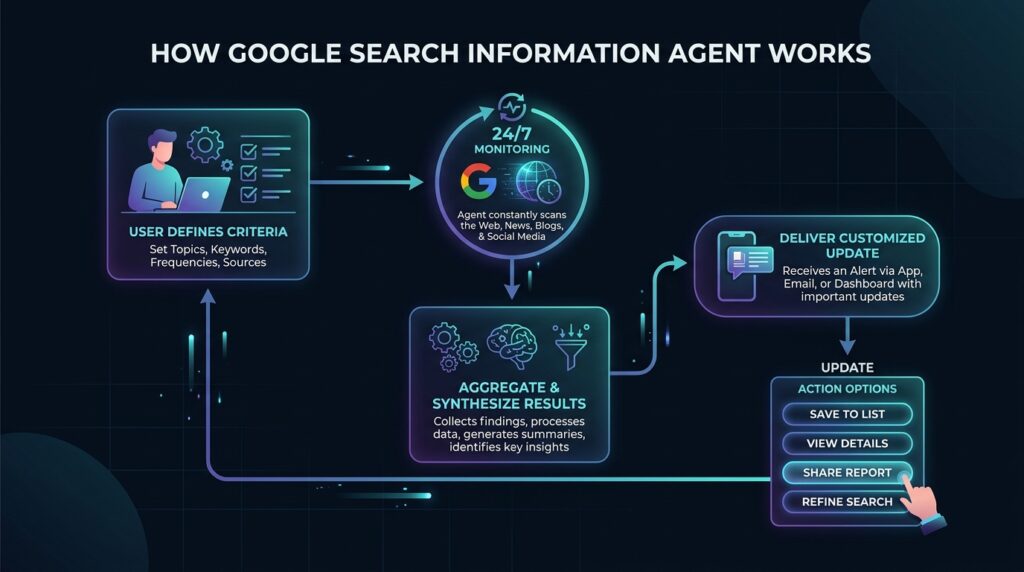
A Google Search information agent is a persistent, background AI process that you configure through Search. It continues to monitor the web, including blogs, news sites, social posts, real-time financial data, sports scores, and shopping listings, then synthesizes updates relevant to a specific goal you have defined.
You do not have to search for it again. The agent runs while you sleep, while you work, while you are doing anything else. When it finds something that matches your criteria, it surfaces a synthesized update and, in some cases, offers direct action.
What That Looks Like in Practice
Google gave two examples worth walking through because they illustrate the range of what this unlocks.
The first is apartment hunting. Instead of running the same search every day and scrolling through listings, you tell the agent your exact criteria: neighborhood, price range, floor preferences, pet policy, proximity to transit. It monitors listings continuously and does not just send you a raw link. It sends a synthesized update when something matches, with enough detail to decide whether to act.
The second is sneaker releases. If you follow specific athletes and want to know the moment one announces a new collab or product drop, the agent watches for that specific signal across the web and alerts you the instant it appears.
These examples sound simple. But the underlying capability, a persistent, reasoning, web-monitoring process that understands nuanced criteria and synthesizes results rather than just surfacing links, represents a fundamentally different relationship between a user and a search engine.
Information agents launch first for Google AI Pro and Ultra subscribers this summer.
The Search Box Got Its First Real Upgrade in 25 Years
It is easy to overlook the interface change when there is a lot happening in an announcement. But the new Google Search box deserves more attention than it is getting.
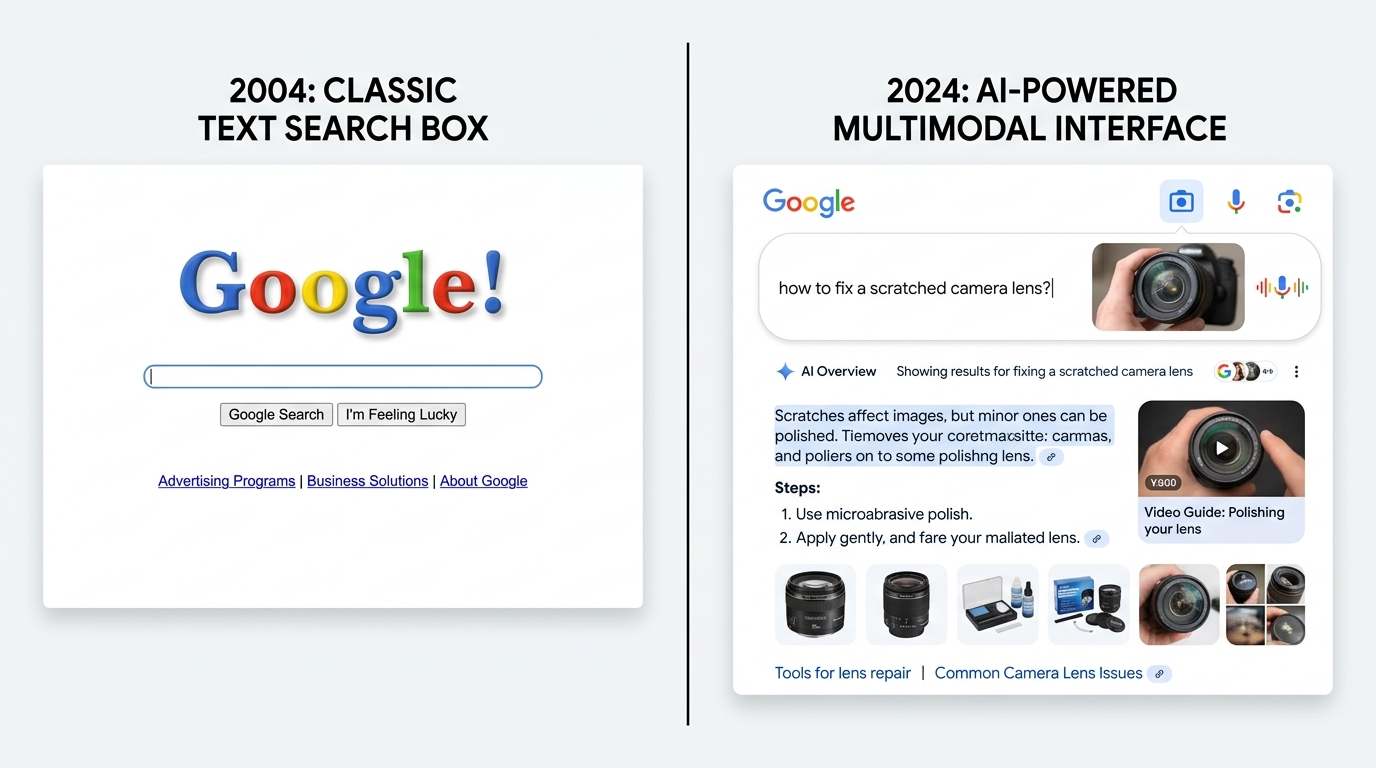
The original Google Search box, the white rectangle with the “Google Search” button underneath, has been essentially the same for over two decades. Yes, it gained autocomplete, voice input, and later image search. But the fundamental paradigm, a single-line text field, stayed constant.
That is changing.
The new intelligent Search box is built around a different premise: that the way people actually want to search does not always fit into a keyword or a short phrase. The updated interface:
- Dynamically expands as you type, giving you space to describe complex, multi-part questions in natural language without feeling constrained by a small text field.
- Offers AI-powered suggestions that go meaningfully beyond autocomplete, not just completing what you are typing but helping you formulate a better version of what you are trying to ask.
- Accepts multiple input types simultaneously, including text, images, uploaded files, videos, and open Chrome tabs, as part of the same search context.
The practical implication of that last point is significant. If you are researching a product and have a screenshot, a spec sheet PDF, and a YouTube review open in separate tabs, you can bring all of that into a single Search query rather than triangulating across multiple separate searches.
The new Search box is rolling out today in all countries and languages where AI Mode is available.
AI Mode Hit One Billion Users: Here Is Why That Number Matters
AI Mode launched one year ago. It now has over one billion monthly users. Queries are more than doubling every quarter.
That growth rate is worth pausing on, because it tells you something concrete about how quickly users adapt when a better search experience exists.
AI Mode is Google’s conversational search layer. It lets you ask complex, multi-part questions and get synthesized answers rather than a list of links, then follow up naturally as if in a conversation. The fact that it reached a billion users in a year, with compounding query growth, suggests that the population of people who prefer this kind of search experience is large and was waiting for a version that worked well enough to switch to.
For publishers, SEO professionals, and content creators, this trajectory has real implications. The percentage of Google searches that result in a direct click to a website has been declining. AI-synthesized answers that resolve a query without requiring a click accelerate that trend. Understanding how to be cited within AI Mode responses, not just how to rank in traditional blue-link results, is becoming the relevant question.
Agentic Booking: Google Now Calls Businesses on Your Behalf
There is a specific agentic capability buried in the I/O announcement that deserves its own treatment: the expansion of agentic booking in Search.
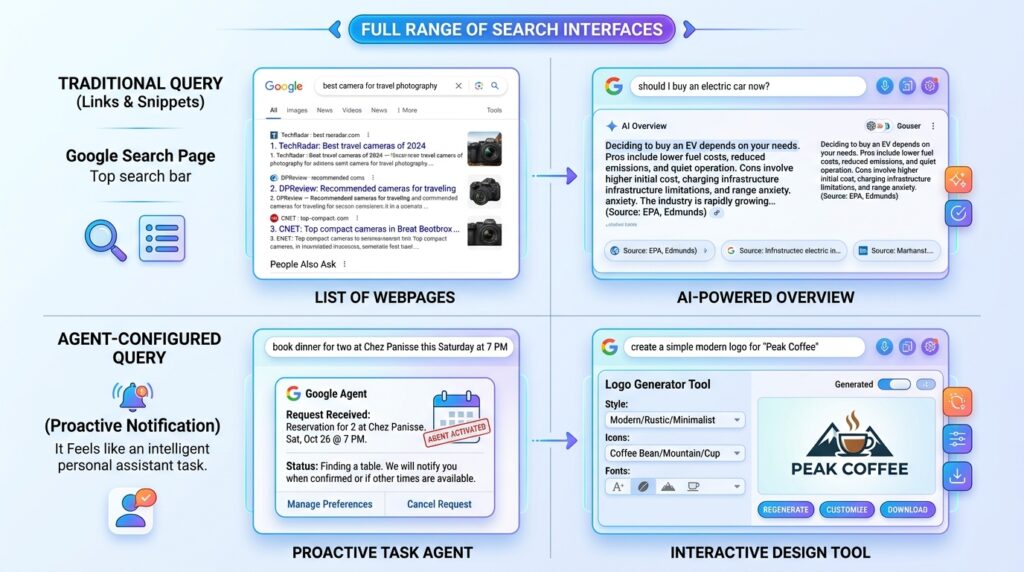
The setup: you describe what you are looking for with specific criteria, like finding a private karaoke room for six people on a Friday night that serves food late, and Search aggregates real-time pricing and availability and surfaces direct booking links.
That is impressive but not entirely new territory. What is new is the extension to services and the ability for Google to call businesses on your behalf in select categories, including home repair, beauty, and pet care, to check availability, ask questions, and facilitate scheduling without you having to make the call.
This is a material shift in the role Search plays in the transaction funnel. It moves from discovery and intent to active participation in the path to purchase. For local businesses and service providers, the implications run in two directions.
On one hand, it expands the effective reach of their booking availability by making it accessible through Search directly. On the other, it introduces a layer of AI mediation between the business and the potential customer that changes the nature of the first interaction.
These capabilities roll out to all US users this summer.
Generative UI and Mini Apps: When Your Search Result Is a Tool
This might be the most underappreciated announcement in the entire I/O update. It is also the one that most directly changes what “a search result” means.
Google Search can now build custom generative UI, including interactive visuals, tables, graphs, and simulations, in real time, tailored to the specific question you asked. Not a pre-built template. Not a widget pulled from a third-party source. A dynamically assembled interface generated specifically for your query.
Want to understand how a mechanical watch works? Search does not serve you an article. It builds you an interactive diagram. Want to understand the relationship between interest rates, inflation, and housing prices over the last ten years? It generates a dynamic visualization. Want to wrap your mind around a concept in astrophysics? It builds a simulation.
The Mini App Step
The capability goes further. For recurring tasks like planning a wedding, tracking a fitness routine, or managing a home renovation, Search can build you a persistent custom dashboard that you return to over time. It pulls in real-time data like local weather or live maps and functions as a purpose-built tool for your specific ongoing project.
Google is calling these “mini apps.” They are built through Antigravity, Google’s new agentic development platform, and powered by Gemini 3.5 Flash doing real-time coding to assemble the interface on the fly.
Generative UI features roll out to all users in Search this summer for free. Mini app building starts with AI Pro and Ultra subscribers in the US.
Personal Intelligence: Search That Understands Your Context
The last major announcement has implications that extend well beyond convenience.
Personal Intelligence in AI Mode connects your Google apps, including Gmail, Google Photos, and soon Google Calendar, to your Search experience. This allows Search to understand your personal context when forming responses.
This is now expanding to nearly 200 countries and territories across 98 languages, with no subscription required.
The practical value is specific and significant. Ask AI Mode what you agreed to in your last contract negotiation and it can reference your Gmail. Ask it to help you plan a trip and it knows from your Photos where you have been and from your Calendar when you are available. Ask it to find a restaurant for an anniversary dinner and it knows when your anniversary is.
Google has been deliberate in communicating that this is opt-in, transparent, and user-controlled. You choose which apps to connect, and you can disconnect them at any time. The company’s emphasis on these controls reflects the sensitivity of the use case. Connecting your email and photos to a search engine is a meaningful privacy decision, and how users navigate that tradeoff will be one of the more interesting adoption patterns to watch over the next year.
What This Means for SEO, Marketing, and Content in 2026
For anyone whose work depends on search traffic, the I/O 2026 announcements are not just a product update to be aware of. They are a signal about where the return on content investment is heading.
The shift to citation over click accelerates with AI Mode at a billion users and information agents running in the background. Being the source that AI Mode synthesizes from, through strong, clearly structured, authoritative content, matters more than raw click volume. Structured data, clear factual claims, and demonstrable expertise are the ranking signals most likely to survive this transition.
Personalized search changes competitive dynamics. When Search incorporates Gmail context, two users searching for the same thing may get meaningfully different results based on their personal data. This makes broad, generic content less relevant and specific, contextually useful content more valuable.
For local businesses, agentic booking creates both an opportunity and a dependency risk. Being accessible through Google’s booking layer could drive significant new transaction volume. But it also means Google sits more directly between the business and the customer than it ever has before.
For content creators, generative UI is the most significant challenge. If Search can generate an interactive tool in real time that answers a question better than a static article can, the value of producing that article declines. The content types most resilient to this shift are original reporting, first-person experience, opinions, and research that no AI can synthesize because it does not exist as published source material.
Where Google Search Goes From Here
The thread connecting every announcement at I/O 2026 is the same: Search is moving from reactive to proactive, from query-response to ongoing relationship, from link aggregator to active participant in tasks.
Information agents are the clearest expression of that direction. They represent a Search that does not wait for you to ask. It monitors, synthesizes, and surfaces on your behalf. That is a different product category from what Google has been for most of its existence.
The 25-year-old Search box being redesigned is the symbolic marker of that transition. The interface has not changed because the underlying search model has not changed. Now that both are changing together, the redesign reflects a real shift in what the product is for.
For users, the direction is mostly favorable: more powerful tools, more personalized results, less manual effort. For publishers, creators, and businesses that built their models on search traffic, the adaptation required is real and the window for getting ahead of it is shortening.
Conclusion
Google Search information agents are not a feature update. They are a preview of what Search becomes when it is no longer limited to responding to queries you have already thought to ask.
That is the underlying story of I/O 2026. The individual announcements, including Gemini 3.5 Flash, the new Search box, generative UI, and Personal Intelligence, are components of the same transition: a search engine becoming a proactive, context-aware, task-executing assistant that operates on your behalf across the entire information environment.
For most users, that is a meaningful improvement over what Search has been. For anyone whose strategy depends on knowing what Search is doing and why, including marketers, SEO professionals, content creators, and business owners, this is the moment to update the mental model. The old one was accurate for a long time. It is becoming less accurate quickly.