
Key Takeaways
- Model Context Protocol (MCP) is an open standard that defines how AI models connect to external tools, databases, and APIs through a single, consistent interface instead of one-off custom integrations.
- MCP uses a client-server architecture built on JSON-RPC 2.0, with three core primitives: Tools (actions the AI executes), Resources (data the AI reads), and Prompts (reusable workflow templates).
- The MCP ecosystem has already crossed 97 million SDK downloads and 13,000+ servers on GitHub, covering everything from GitHub and PostgreSQL to Stripe and Docker.
- You do not need to write raw CUDA or deeply understand LLM internals to build with MCP. If you have shipped REST APIs, the mental model transfers almost directly.
- Anthropic donated MCP to the Linux Foundation’s Agentic AI Foundation in December 2025, making it a vendor-neutral industry standard backed by Anthropic, OpenAI, Google, Microsoft, AWS, and Block.
Table of Contents
Introduction
Imagine you are building an AI assistant for your product. You want it to query your database, read files, call a third-party API, and trigger actions in your backend. Without a standard, you write a custom integration for every single one of those connections. Every model update can break your wrappers. Every new tool requires new glue code. You end up maintaining a pile of brittle adapters instead of shipping features.
That is exactly the problem Model Context Protocol (MCP) was built to solve.
If you have been seeing MCP mentioned everywhere in developer communities over the last several months and still do not have a clean mental model of what it actually is, this article fixes that. We will cover what MCP is, how its architecture works, what the three core primitives do, and what this means for you as a developer building AI-powered applications in 2026.
What Is Model Context Protocol (MCP)?
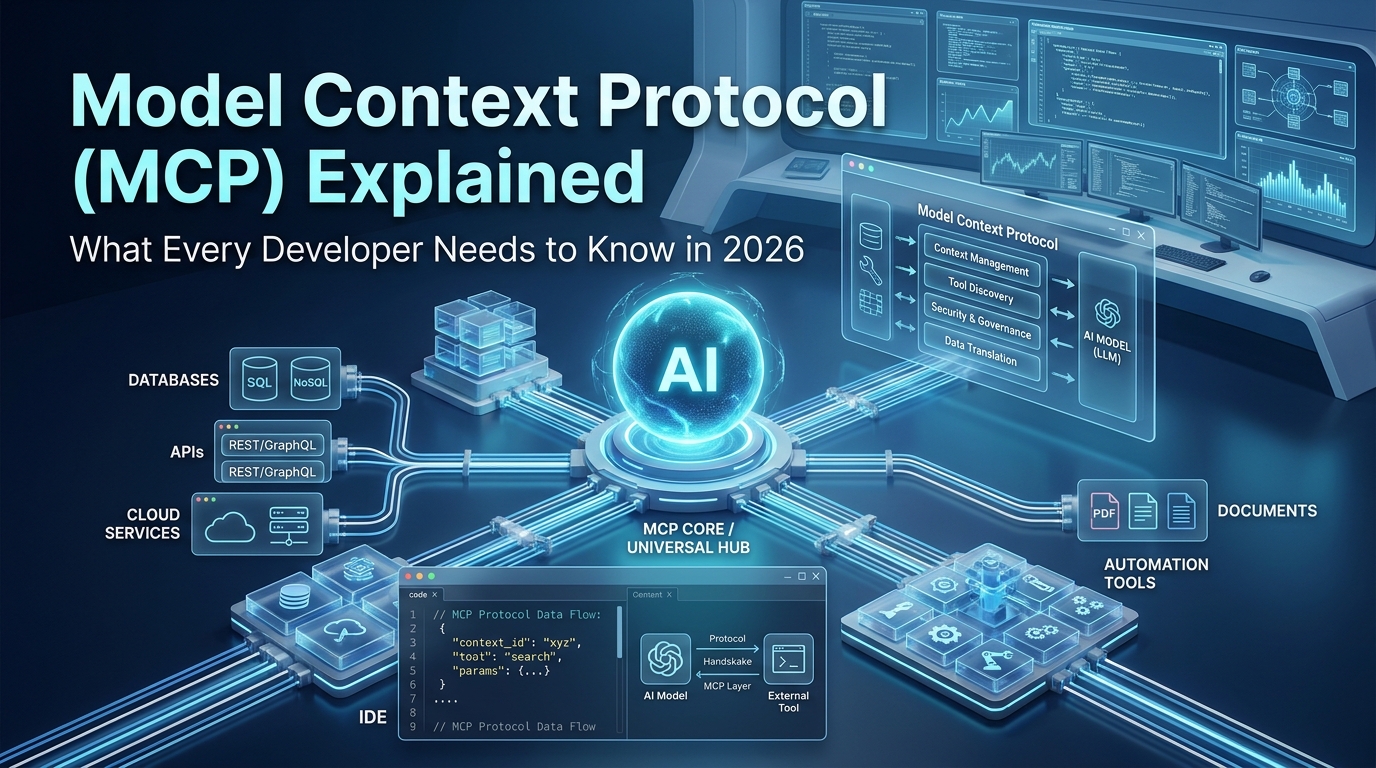
Model Context Protocol is an open, vendor-neutral standard released by Anthropic that defines how AI models connect to external tools, databases, and APIs. It replaces custom point-to-point integrations with a single client-server protocol using JSON-RPC 2.0, enabling any MCP-compatible AI host to discover and invoke tools, read data resources, and use prompt templates.
The analogy the community has widely adopted is USB-C. Before USB-C, every device manufacturer shipped proprietary chargers. Developers accumulated drawers full of incompatible adapters. USB-C replaced that chaos with a single universal standard. MCP does the same for AI-tool connectivity. You write an MCP server once for your tool or data source, and every AI host that speaks the protocol can pick it up immediately. No per-model adapter. No per-client integration. One server, universally compatible.
Anthropic released MCP as an open-source protocol in November 2024. Although the initial release targeted Claude Desktop, the protocol was designed from the start to be model-agnostic and tool-agnostic. Within months, OpenAI, Google DeepMind, and Microsoft had adopted it. By the end of 2025, it had become infrastructure for anyone building serious agentic applications.
The spec and documentation are published at modelcontextprotocol.io. Official SDKs cover the languages most development teams actually use: TypeScript, Python, Go, Kotlin, Java, C#, Swift, Rust, Ruby, and PHP.
The Problem MCP Solves (And Why It Matters Now)
To understand why MCP gained adoption so quickly, you need to feel the pain it replaces.
Before MCP, connecting an AI model to external tools meant writing a custom integration layer for every combination of model and service. Want your LLM to query a PostgreSQL database? Write a function-calling wrapper. Want it to read from GitHub? Write another integration. Want it to work with a different model provider next quarter? Rewrite all of it because each provider had a different tool-calling spec.
This is not a theoretical inconvenience. It was the primary reason production AI features were so expensive to build and maintain. The integrations were harder to manage than the AI logic itself.
MCP solves this with a standard contract. You build an MCP server once for your tool or data source. Any MCP-compatible client, whether that is Claude Desktop, Cursor, VS Code with the Copilot extension, or your own custom AI agent, can connect to it immediately without any additional integration work.
Teams that moved away from custom function-call wrappers to an MCP-native setup have reported the time to wire up a new tool integration falling from multiple days down to under fifteen minutes. That is not a marginal improvement. That is a fundamentally different workflow. That kind of productivity delta is why adoption moved this fast.
How MCP Works: The Architecture
MCP has three components that you need to understand before anything else makes sense.
Host
The host is the application that runs the AI model and manages the overall user interaction. Claude Desktop is a host. Cursor is a host. If you build your own AI-powered application that orchestrates LLM calls, that application is the host.
Client
The client lives inside the host. It handles the actual MCP connections, maintains sessions with MCP servers, and routes tool calls and responses between the LLM and the servers. When the LLM decides it needs to call a tool, the client is what actually executes that protocol conversation.
Server
The MCP server is what you build as a developer. It exposes your tools, data, and prompt templates through the MCP protocol. It could be a lightweight local process or a cloud-deployed service. An MCP server operates as a focused process that exposes specialized context and capabilities via standardized protocol primitives to any connected client.
Transport Layers
MCP supports two transport modes. Stdio transport is for local subprocess communication, which is ideal for desktop apps and development environments. Streamable HTTP transport uses HTTP POST for client-to-server messages with optional Server-Sent Events for streaming responses, which is the standard for remote servers and supports OAuth authentication, multi-client connections, and cloud deployment. The MCP specification introduced Streamable HTTP in March 2025, replacing the earlier SSE-only transport.
The practical implication: if you are building an MCP server for local developer tooling, use stdio. If you are building something that needs to run in the cloud and serve multiple AI clients at once, Streamable HTTP is your transport.
The Three MCP Primitives
Most MCP tutorials show you how to build a tool, call it from Claude Desktop, and stop there. That covers maybe a third of what MCP actually gives you. There are three primitives in the spec: Tools, Resources, and Prompts. Each one has a distinct role and a distinct ownership model. Getting them right is the difference between an MCP server that works in a demo and one that holds up in production.
Tools: Actions the AI Decides to Take
A Tool is a function your MCP server exposes that the AI can invoke autonomously when it determines the task requires it. No user has to manually trigger it. The model evaluates what it needs to do, sees a tool that fits, constructs the arguments, and calls it.
Tools are the right primitive for anything that causes a side effect in an external system. Writing a record to a database, sending a notification, triggering a deployment pipeline, calling a third-party API. Any operation that changes state somewhere belongs here, not in a resource.
Here is a minimal Python MCP server exposing a single tool using the official MCP Python SDK:
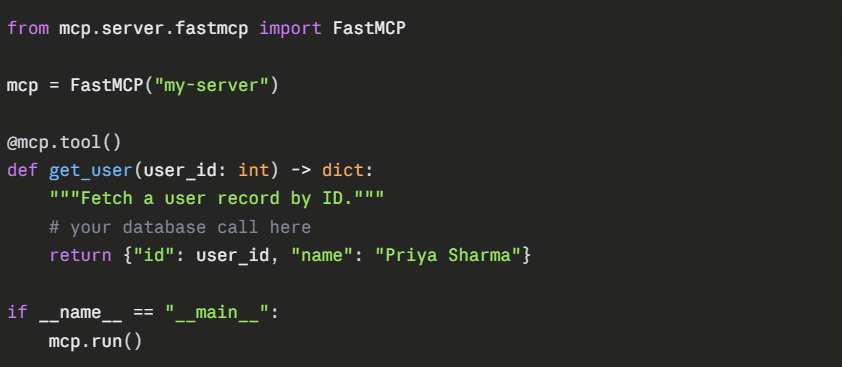
Connect any MCP-compatible client to this server and it will discover get_user automatically at runtime. The model can now call it whenever the user’s request involves looking up a user. You wrote a Python function. The MCP decorator did the rest.
Resources: Context the AI Reads
A Resource is a read-only data source your server makes available for the AI to pull in as context. Database schemas, configuration files, documentation, recent logs — anything the AI needs to understand your system before it acts.
The key distinction from Tools: Resources do not change anything. They are informational, not operational. The host application decides when to surface a resource, not the model. That ownership difference matters for how you reason about access control and caching.

A practical way to think about it: if a junior developer would need to read a document before writing code, that document is probably a Resource. If they would need to run a function to get the job done, that is a Tool.
Prompts: Reusable Workflows for Repeatable Tasks
Prompts are the primitive most MCP tutorials skip entirely, which is a mistake. A Prompt is a pre-defined workflow template that guides how the AI should use your server’s tools and resources for a specific task. Unlike Tools (model-driven) and Resources (host-driven), Prompts are user-controlled. They surface as selectable options that users can invoke intentionally.
Think of a Prompt as encoding an entire workflow into a single, reliable entry point. A weekly sales report that needs to query three different data sources in a specific sequence. An incident response runbook. A customer onboarding checklist. Rather than hoping the model figures out the right tool call order on its own every single time, you define the sequence once and expose it as a repeatable operation.
Most of the MCP ecosystem has built Tools because Tools are easy to demo. Prompts take more thought to design because you have to actually understand the workflow you are encoding. But for any AI integration meant to go into production, Prompts are what give you consistency and predictability at the workflow level.
MCP vs Function Calling: What Is the Difference?
If you have already integrated OpenAI’s function calling or Anthropic’s tool use into an application, you might be wondering how MCP differs. It is a fair question.
Function calling is a feature of a specific model API. You define functions in a JSON schema, pass them to the API, and the model decides whether and how to call them. The integration lives inside your application code. It is tight-coupled to whichever model you are calling.
MCP is a protocol layer that sits above any specific model. The tools you expose through an MCP server are not tied to OpenAI’s schema or Anthropic’s tool spec. Any MCP-compatible model or client can discover and use them through the same standard interface. You build the integration once and it works across the ecosystem.
In practice: function calling is what happens inside a single API call. The result is tool connectivity that is portable across models, discoverable at runtime, and reusable by any team that builds on the same server. That is what function calling inside a single API call has never been.
The MCP Ecosystem in 2026
The MCP registry lists over 10,000 public servers in 2026, covering developer tools like GitHub, GitLab, Sentry, Linear, and Jira; databases like PostgreSQL, Snowflake, Supabase, ClickHouse, and MongoDB; and major SaaS platforms.
If your application integrates with any commonly used developer tool, there is a good chance an MCP server for it already exists. The official MCP server examples are a good starting point, and the community registry on GitHub surfaces community-built servers across virtually every category.
For Node.js developers, the TypeScript SDK makes building a basic MCP server a few dozen lines of code. For Python developers working in ML or backend infrastructure, the Python SDK integrates cleanly with FastAPI-style patterns as shown above.
MCP and A2A: What the Difference Actually Is
If you have been reading about agentic AI infrastructure in 2026, you have probably seen both MCP and A2A mentioned together. Google released the Agent-to-Agent protocol in April 2025, and there was immediate confusion in the developer community about whether it competed with MCP or replaced it. It does neither.
The cleanest way to separate them: MCP handles what happens between an AI agent and a tool. A2A handles what happens between two AI agents.
When your agent needs to query a database, read a file, or call an API, that connection goes through MCP. When your agent needs to hand off a task to a different specialized agent, that handoff goes through A2A. The two protocols operate at different layers of the stack.
A concrete example: a customer support agent uses MCP to pull records from your CRM and search your knowledge base. When the issue requires deep technical debugging that falls outside its domain, it routes the task to a specialist technical agent using A2A. Each agent still uses MCP internally for its own tool access. A2A just handles the handoff between them.
If you are building a single AI feature that connects to external tools, A2A is not relevant yet. Once you start wiring multiple agents together into a coordinated system, the two protocols work in combination.
Security Considerations Before You Ship
In February 2026, OWASP released a practical guide for secure MCP server development. Key practices include: validate all tool inputs against strict schemas, never pass user input directly to shell commands, SQL queries, or file system operations without sanitization, and ensure MCP servers only have access to the resources they actually need.
Two things worth calling out specifically for web developers:
First, treat your MCP server like a public API, not internal tooling. Even if it runs locally today, the threat model should assume it could be exposed. Input validation on every tool argument is not optional.
Second, tool output goes directly into LLM context. Malicious content in a tool response can influence model behavior in ways that are hard to debug. Sanitize what comes back from external sources before it gets injected into your prompt context.
What the MCP Roadmap Means for Developers Building Now
The 2026 roadmap includes better streaming support, richer resource types, and improved sampling capabilities that let MCP servers trigger model calls themselves for multi-agent workflows.
The most significant near-term direction is agentic orchestration. MCP servers can already call other MCP servers. AI agents can act as both clients consuming tools from servers and as servers exposing their own capabilities to other agents. This makes it possible to build layered agent systems where specialized agents handle specific tasks and a coordinator agent routes work between them.
For full stack developers, the near-term opportunity is building domain-specific MCP servers that expose your application’s data and actions to any AI client your users might bring to your product. The teams that build these integrations early will have a significant advantage as MCP-compatible AI tools become the default interface for technical users.
Analyst coverage of the space has been consistent: API gateway vendors are treating MCP support as a near-term roadmap requirement, not a long-term consideration. The adoption curve has moved from experimental to infrastructure-critical inside 18 months. If that holds, the question will not be whether your application supports MCP. It will be how well your MCP server is designed.
Conclusion
Model Context Protocol is the connective tissue of the agentic AI layer that is being built right now. It is not a framework or a library. It is a standard, and standards matter most when an ecosystem is fragmenting fast and every team is about to start building incompatible integrations independently.
The mental model you need is simple: MCP servers expose what your application can do (tools), what it knows (resources), and how it should be used (prompts). MCP clients, which live inside AI hosts, connect to those servers and let any compatible model use your application’s capabilities through a single consistent interface.
The practical next step is straightforward. Pick the official TypeScript or Python SDK, read through the quick start guide, and build a minimal MCP server that wraps one API your application already calls. Get that running in Claude Desktop or Cursor and watch it work. That one working prototype will give you more clarity on where MCP fits in your stack than reading three more articles.
The protocol is stable enough to build on. The ecosystem is large enough to learn from. And the timing, right now in 2026 as agentic AI moves from experimental to production, is about as good as it gets for getting ahead of a standard before it becomes mandatory knowledge.