
Key Takeaways
- OpenAI’s self-serve ChatGPT Ads Manager launched on May 5, 2026, allowing US businesses of all sizes to create and manage ad campaigns that appear inside ChatGPT conversations, with no minimum spend requirement.
- ChatGPT advertising uses conversational context targeting, not cookies, keywords, or user profiles, which makes it fundamentally different from anything in your current marketing stack.
- CPC bidding starts at a recommended $3 to $5 per click, CPMs have dropped to around $25 observed from a $60 default, and the auction is relevance-weighted and second-price, meaning a sharper creative on a smaller bid can beat a lazy big-budget ad.
- The platform is best suited for B2B SaaS, professional services, education, and high-consideration ecommerce brands. Local service businesses and regulated categories like healthcare and finance are not strong fits yet.
- Early movers have a real CPC advantage right now. ChatGPT accounts for 82.6% of all generative AI traffic and OpenAI projects $2.5 billion in ad revenue for 2026. Competition and costs will rise. The window to build early optimization data is open but not permanent.
Table of Contents
Introduction
For the last several years, digital advertising has meant two things for most marketers: Google and Meta. The tools changed, the creatives evolved, and the audiences shifted, but the fundamental model stayed the same. You bid on keywords or audiences, your ad appears in a feed or a search result, and you measure clicks and conversions.
OpenAI’s February 2026 launch of ChatGPT advertising represents the most significant shift in digital marketing since Google AdWords fundamentally changed how businesses reach customers online. And now, with the self-serve ChatGPT Ads Manager open to every US business without a minimum spend requirement, this shift is no longer limited to companies with six-figure agency relationships.
This is not another ad platform with a slightly different audience segment. The OpenAI Ads Manager introduces a completely different unit of advertising: not a keyword, not a demographic, but a conversation. Understanding what that means in practice, how conversational advertising actually works, what it costs today, and which businesses should test it now versus wait, is exactly what this guide covers.
What Is ChatGPT Ads Manager and How Did We Get Here
ChatGPT ads are sponsored messages that appear inside ChatGPT conversations when users ask questions with commercial intent. They launched in February 2026, and as of May 2026, any US advertiser can buy them through a self-serve Ads Manager at ads.openai.com.
The rollout happened in stages that are worth understanding because they reveal how seriously OpenAI has been treating this product.
The February 2026 launch was enterprise-only. The $200,000 monthly minimum that gated the March 2026 pilot was lowered to $50,000 in April and removed entirely when ChatGPT Ads Manager opened to all US businesses on May 5, 2026. That progression, from $200,000 to $50,000 to zero, mirrors exactly how Google and Meta expanded their platforms in the early years and is a deliberate signal about where OpenAI intends to take this.
OpenAI processes 2.5 billion daily prompts from hundreds of millions of active users, commanding a significant market share in AI chatbots. That is the audience sitting on the other side of every ChatGPT ad. Unlike social platforms where attention is split across feeds, stories, and notifications, ChatGPT users are in an active problem-solving or research mode when they see an ad. That context is what makes the AI advertising platform fundamentally different from anything that came before it.
How ChatGPT Ad Targeting Actually Works
This is the section most marketers misread, and getting it wrong leads to wasted budget. ChatGPT ad targeting does not work the way Google Ads or Meta Ads work. There are no keyword lists, no audience segments, no lookalike modeling, no retargeting pools.
Targeting is intent-based, powered by conversational context, with no cookies and no user profiles. What that means in practice: OpenAI’s system reads the live conversation to understand what the user is trying to accomplish, then determines whether a relevant ad is appropriate for that moment.
Advertisers can target broad topics, user intents such as “comparing products,” and supply example prompts that match their customers’ questions.
Think of it less like selecting a keyword and more like describing the kind of conversation you want your brand to show up in. A project management SaaS company does not bid on “project management software.” It describes the types of conversations where its product is relevant: someone comparing tools, someone asking how to organize a remote team, someone researching solutions for tracking client deliverables.
What the Ad Unit Looks Like
The single ad format documented today is called a chat_card. It carries a 3 to 50 character title, up to 100 characters of body copy, an image, a favicon, and a target URL.
Ads appear as clearly labeled units below relevant ChatGPT responses. They are not injected into the AI’s answer itself. The response the user gets is uninfluenced by the advertiser. The ad appears beneath it, contextualized by the conversation that just happened.
OpenAI has signaled that more formats will follow, but for now the chat_card is the only documented self-serve format.
Who Sees the Ads
Ads appear to Free and Go tier users in the US, Canada, Australia, and New Zealand. ChatGPT Pro and higher subscription users do not see ads. This is the same model that Google and Meta used to establish advertising in freemium products and it creates a large, commercially active audience without alienating paying subscribers.
A company spokesperson confirmed that fewer than 20% of eligible users were being shown ads daily during the pilot, which means the ad density is deliberately low right now. That is good news for early advertisers. Lower density means less competition for attention and stronger click-through rates before the inventory fills up.
ChatGPT Ads Pricing: What It Actually Costs in 2026
The CPC bidding ChatGPT structure is one of the more practical parts of the platform to understand because it determines whether a test budget makes sense for your business.
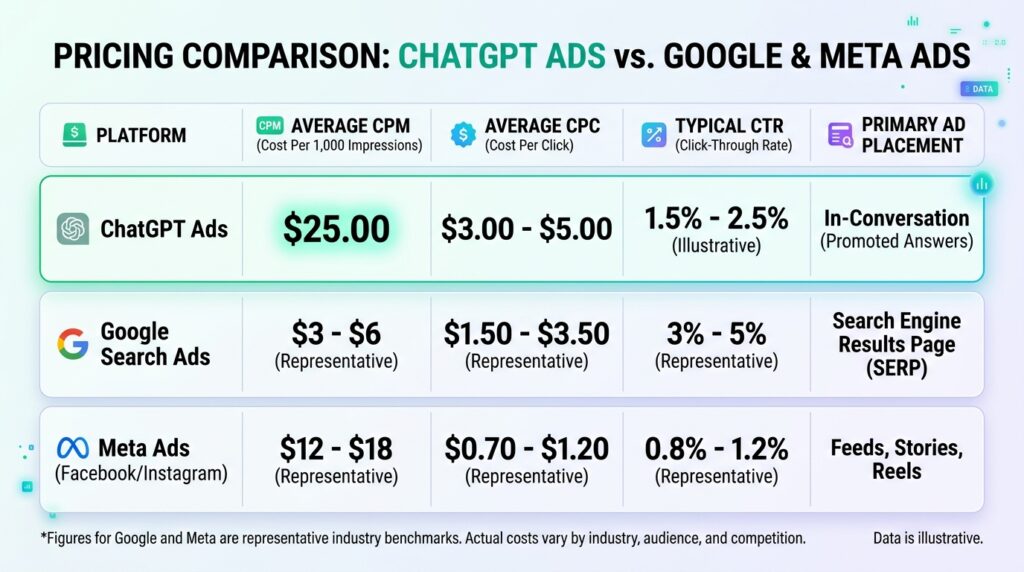
CPC bidding starts around $3 to $5 per click, CPMs have fallen as low as $25, and a Conversions API now lets you tie ChatGPT impressions to closed revenue.
For context, Google Search CPCs in competitive B2B categories regularly run $15 to $50 per click. Meta CPCs for similar audiences typically range from $2 to $8 but with significantly less intent signal behind them. A $3 to $5 CPC on an audience actively researching a purchase decision represents strong value relative to those benchmarks, at least at current competition levels.
The auction is relevance-weighted and second-price, so a tighter creative on a smaller bid can beat a lazy big-budget ad. This is an important detail for smaller advertisers. The ChatGPT advertising auction rewards relevance, not just spend. A well-written, tightly targeted chat_card from a startup can outplace a broadly written ad from a major brand that has not spent time thinking about conversational context.
The Revenue Trajectory That Explains the Urgency
Six weeks into a limited US pilot, ChatGPT’s ad platform had already generated over $100 million in annualized revenue, demonstrating immediate advertiser demand. OpenAI projects $2.5 billion in ad revenue for 2026 across the full platform.
That growth rate tells you where CPC prices are heading. Early Google Ads advertisers paid fractions of a dollar per click. Early Facebook advertisers paid CPMs that look laughable compared to today’s rates. The window to build optimization data and audience insights before ChatGPT ad performance benchmarks become expensive is exactly the same window that existed in those early years. It is open right now. It will not stay open.
ChatGPT Ads vs Google Ads vs Meta Ads: The Honest Comparison
Understanding where the self-serve AI ad platform fits in a media mix requires an honest comparison with what marketers already know.
Intent Signal Quality
Google Search remains the strongest intent signal in digital advertising. Someone typing a query into Google has expressed a specific need in the most direct way possible.
ChatGPT conversations arguably go further. A user asking ChatGPT to help them evaluate project management tools, compare pricing structures, or understand which features matter for a remote team is not just expressing intent. They are revealing their decision-making context. That depth of signal is something keyword-based systems cannot capture.
Meta sits at the other end of this spectrum. Meta targeting reaches the right demographic profile but at a much earlier and less defined stage of intent.
Targeting Control
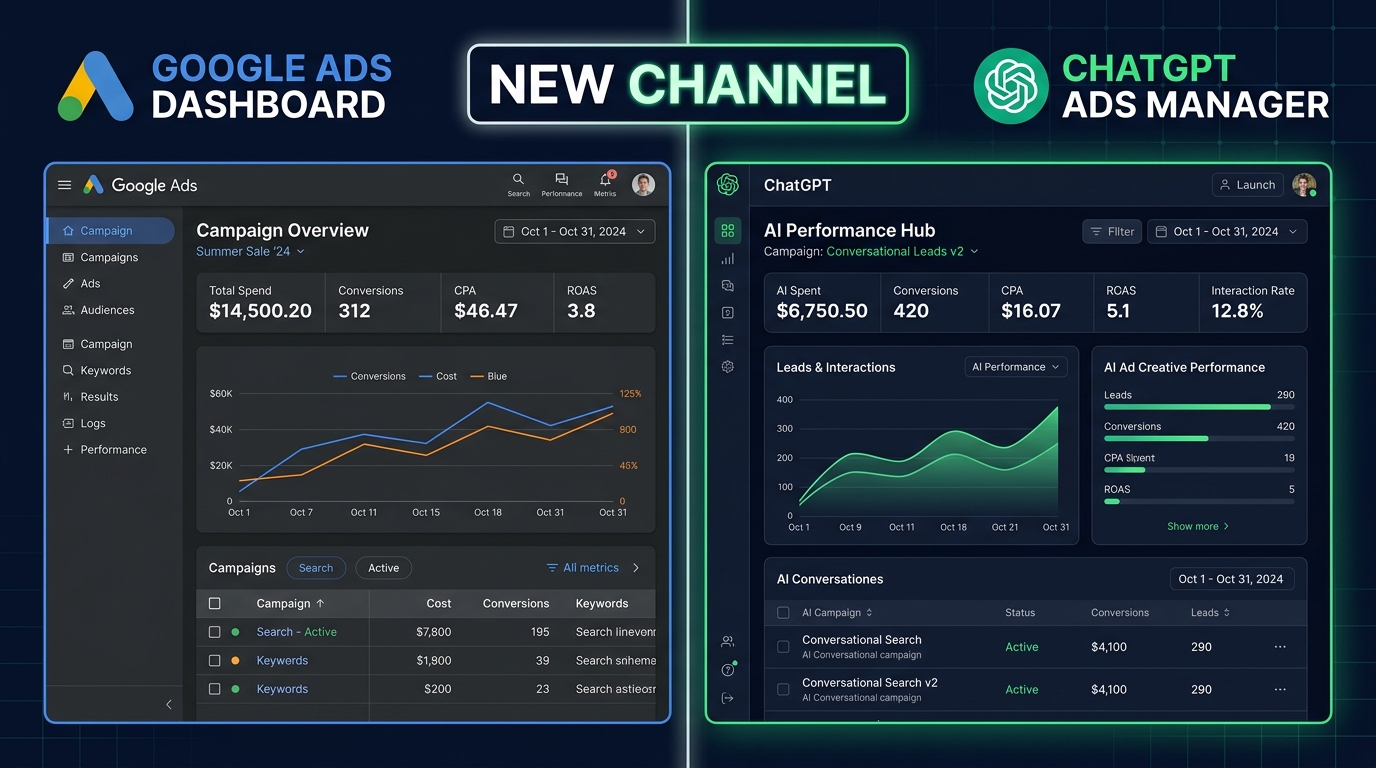
This is where ChatGPT vs Google Ads comparisons get nuanced. Google Ads gives advertisers precise control over keyword matching, negative keywords, bid adjustments by device and location, and extensive audience layering. ChatGPT Ads Manager today offers broad conversational topic targeting and intent categories but lacks the granular control that experienced Google Ads managers are used to.
What is not yet publicly documented includes attribution windows, view-through methodology, lift studies, incrementality tooling, and most of the advanced attribution language Google and Meta planners are used to citing in business cases.
That transparency gap is a real limitation for performance marketers who need to justify spend to stakeholders with precise ROAS figures. It will improve as the platform matures, but it is worth factoring into early test budget expectations.
Measurement
OpenAI supports conversion tracking via a web pixel and a Conversions API, so you can measure actions like purchases, leads, and sign-ups after someone clicks your ad.
OpenAI’s documented expectation is that ChatGPT ads landing pages must be valid and must not block two specific user-agents: OAI-AdsBot and OAI-SearchBot. Check your robots.txt and any bot-blocking configurations before launching. Blocking these user-agents will prevent your campaigns from serving properly.
Who Should Test ChatGPT Ads Right Now
Not every business is equally positioned to benefit from contextual AI ads at this stage of the platform. Here is an honest breakdown.
Strong Fits
- B2B SaaS companies are the clearest early opportunity. Their buyers research solutions through complex multi-turn conversations: comparing features, understanding pricing structures, evaluating integration requirements. That is exactly the kind of conversation where a well-placed ad for the right tool lands naturally.
- Professional services firms in consulting, legal tech, HR tech, and financial services advising face the same dynamic. High-consideration, high-value decisions with long research cycles benefit from appearing in the research conversation itself.
- Online education and training platforms have an audience that actively uses ChatGPT to learn. Being visible when that audience asks about skill development, certifications, or career transitions is a direct match between platform behavior and advertiser objective.
- High-consideration ecommerce where the buyer is comparing options and researching before purchasing, rather than impulse buying, fits the intent profile of ChatGPT’s commercial conversations well.
Wait and Watch
Local service businesses, healthcare providers, financial services regulated under strict advertising guidelines, and businesses with very short purchase cycles where Google’s bottom-of-funnel search intent is already converting efficiently should wait for the platform to mature before testing. The platform is currently not an ideal fit for these categories.
How to Get Started With the OpenAI Ads Manager
The practical steps are straightforward for US businesses.
Access the platform at ads.openai.com. Submit your advertiser registration for review. OpenAI reviews all campaigns before they serve, so build review time into your launch timeline.
Advertisers can create ads through the tool directly or through agency partners such as Dentsu, Omnicom, Publicis, and WPP. Technology partners including Adobe, Criteo, Kargo, Pacvue, and StackAdapt are also integrated with the platform. If you are already working with any of these partners, ask specifically about their ChatGPT Ads capabilities as their integrations are already live.
For creative, think differently than you would for a Google or Meta ad. You are not interrupting a scroll or appearing beside a search result. You are appearing below a conversation the user was just engaged in. Your chat_card headline should be directly relevant to the topic of that conversation. Your body copy should offer something that extends the value of what the user was just doing, not a generic brand message.
Start with a small, well-defined test. One target intent category. One creative variant. Measure post-click behavior carefully. The optimization data you build now will be worth significantly more than the same data collected a year from now when competition has increased and CPCs have risen to match it.
Where OpenAI Advertising Is Heading
The OpenAI advertising revenue trajectory is not slowing down. The platform launched in February, removed spend minimums in May, and is projecting $2.5 billion in revenue before the year ends.
What comes next is not hard to anticipate. More ad formats beyond the chat_card. Expanded geographic availability beyond the US, Canada, Australia, and New Zealand. Deeper measurement and attribution tools that close the transparency gap performance marketers need. And eventually, the same kind of granular audience and intent controls that took Google Ads years to build.
The marketers who will be best positioned for each of those platform improvements are the ones who have already run campaigns, built conversion tracking integrations, and developed creative frameworks that work in conversational contexts. Platform learning compounds. The optimization advantage of early adoption in new ad channels has proven itself consistently across every major platform that came before this one.
Early advertisers can capture lower CPCs, build optimization data, and gain platform-specific creative experience before competition increases. That opportunity exists right now in a way it will not exist twelve months from now.
Conclusion
The ChatGPT Ads Manager is not a future channel to keep an eye on. It is a live platform, open to US businesses today, with real pricing data, real conversion tracking, and a real audience of hundreds of millions of users actively researching decisions.
The conversational advertising model it introduces requires a different creative approach, a different targeting mindset, and a different measurement framework than what most marketers have built for Google and Meta. Those differences are also exactly why the early data and optimization insights you build now are difficult to replicate later.
For B2B SaaS companies, professional services firms, and education platforms especially, the combination of low current CPCs, high commercial intent, and low ad density makes this the most attractive new channel test of 2026. The window is open. How long it stays this way depends entirely on how quickly your competitors figure that out.