
Key Takeaways
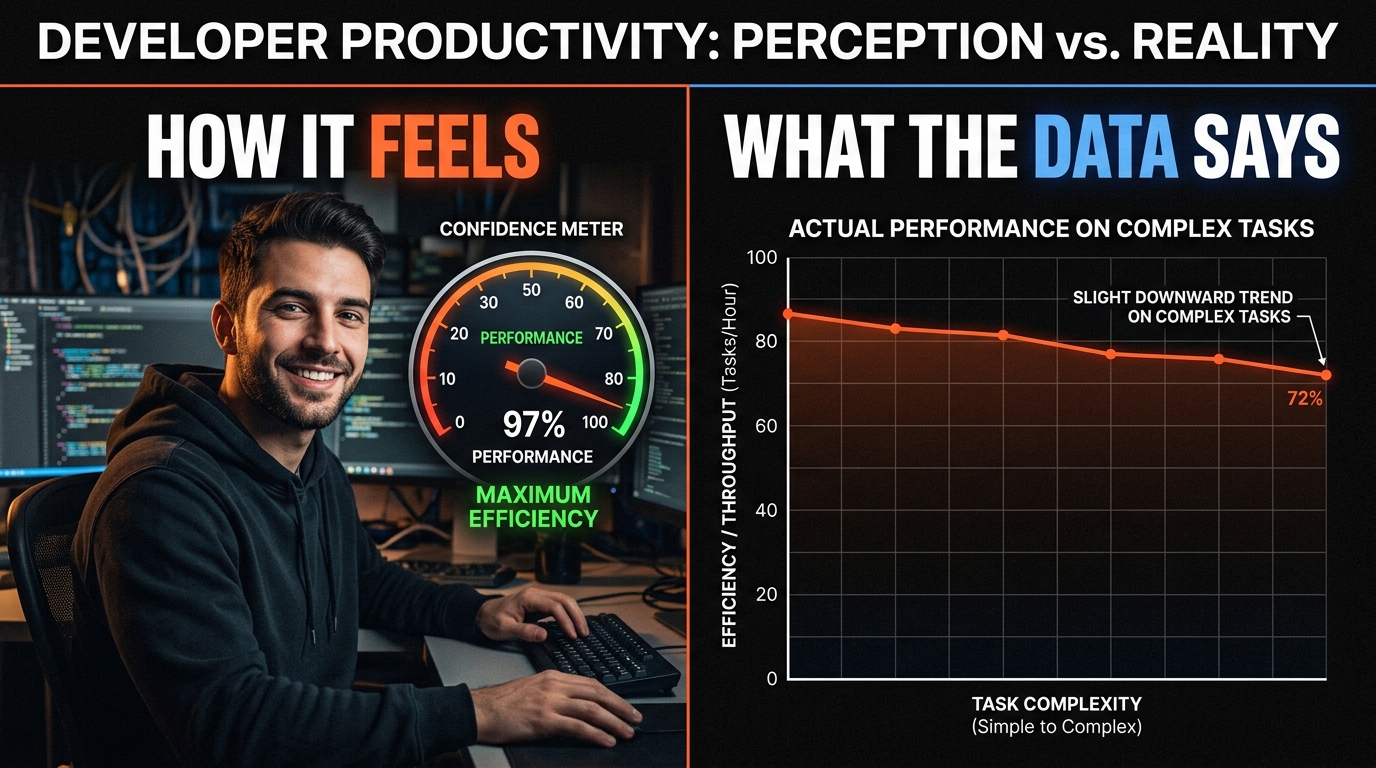
- According to a METR randomized controlled trial published in 2025 and widely cited in 2026 analysis, experienced developers on real codebases predicted they would be 24% faster with AI tools. They came out 19% slower. After the study ended, they still believed they had been 20% faster. The gap between perceived and actual productivity is the central story of vibe coding right now.
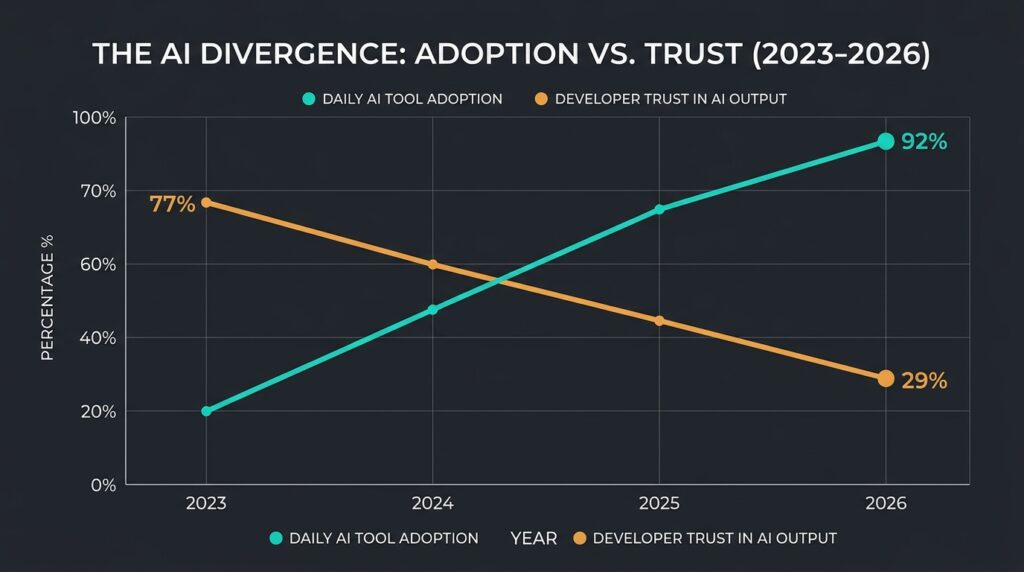
- 92% of US developers use AI coding tools daily in 2026, according to the Stack Overflow Developer Survey 2025, but developer trust in that output has dropped from 77% in 2024 to just 29% in 2026, per Keyhole Software’s enterprise vibe coding research aggregating 14 industry reports.
- AI-generated code contains approximately 2.74 times more security vulnerabilities than human-written code, according to security audits cited by Ortem Technologies’ 2026 vibe coding analysis, yet only 48% of developers always review AI code before committing it.
- The productivity gains from vibe coding are real, but they concentrate in specific tasks: boilerplate, scaffolding, and CRUD operations show up to 81% time savings, while complex business logic, debugging, and legacy system integration show negative or near-zero net benefit.
- Gartner forecasts that prompt-to-app approaches without proper governance will increase software defects by 2,500% by 2028. The same firm predicts 40% of new enterprise production software will be built using vibe coding techniques by the same year. Both forecasts are correct simultaneously. Your job is to end up on the right side of that gap.
Table of Contents
Introduction
Let me tell you exactly where the vibe coding conversation breaks down.
Someone posts a thread showing they built an entire SaaS product in a weekend using Cursor. Zero hand-written code. It works. Users sign up. The comments flood in. Two weeks later the same person posts again: random things are happening, API keys maxed out, users bypassing the subscription, garbage data accumulating in the database. They cannot debug it. They did not write it. Every fix breaks something else. The product shuts down permanently.
That arc is not an edge case. It is the pattern underneath the vibe coding productivity 2026 data when you read past the headline numbers.
This is not an argument against using AI coding tools. I use them daily. The McKinsey February 2026 study of 4,500 developers across 150 enterprises found a 46% reduction in routine coding task time, translating to 3.6 hours saved per week per developer, according to 13Labs’ verified vibe coding statistics. Those gains are real and they compound when you apply them to the right categories of work.
But 92% daily adoption running alongside a 29% trust rate is not a success story. It is a warning signal that most teams are moving faster toward a cliff they have not spotted yet.
This article is what the data actually says about where AI-assisted coding delivers and where it quietly destroys the time it appeared to save.
The METR Finding That Should Have Changed the Conversation
There is one study that deserves to sit at the center of every vibe coding discussion happening in 2026, and most coverage either buries it or omits it entirely.
The METR organization ran a randomized controlled trial using experienced open-source developers working on real production codebases of over one million lines of code. These were not interns or students. They were senior contributors with deep familiarity with the codebases involved. They were timed completing real tasks both with and without AI coding tools.
Before the experiment, these developers predicted they would complete work 24% faster with AI assistance. When the results came back, they had been 19% slower. Not 24% faster. 19% slower.
The result that makes this genuinely unsettling: even after the study concluded and the actual timing data was shown to them, the developers still believed they had been approximately 20% faster. The subjective experience of speed and the objective measurement of speed had completely decoupled.
This is not a cherry-picked outlier finding. Keyhole Software’s aggregated research covering data from 14 industry reports confirms the broader pattern: 95% of developers report feeling productive while measurably producing lower-quality code on complex tasks, and 74% report productivity increases even as quality metrics decline.
The explanation is not mysterious once you think about it from a developer’s perspective. Writing code is a high-cognitive-overhead activity that requires holding a mental model of the system in your head while navigating it. When AI generates the code, that overhead feels reduced because the mechanical work disappears. But the mental model has not been built. When the AI-generated code has a subtle bug buried three abstraction layers deep, you are debugging without the architecture trace that comes from having written the code yourself. The debugging time is invisible at the moment of generation and very visible later.
This is what the vibe coding statistics on shorter task completion time and longer overall delivery timelines are actually measuring. Vibe coding compresses the first number and often expands the second one. The teams winning with it in 2026 are tracking both separately, not just celebrating the first.
The Productivity Data Sorted Honestly
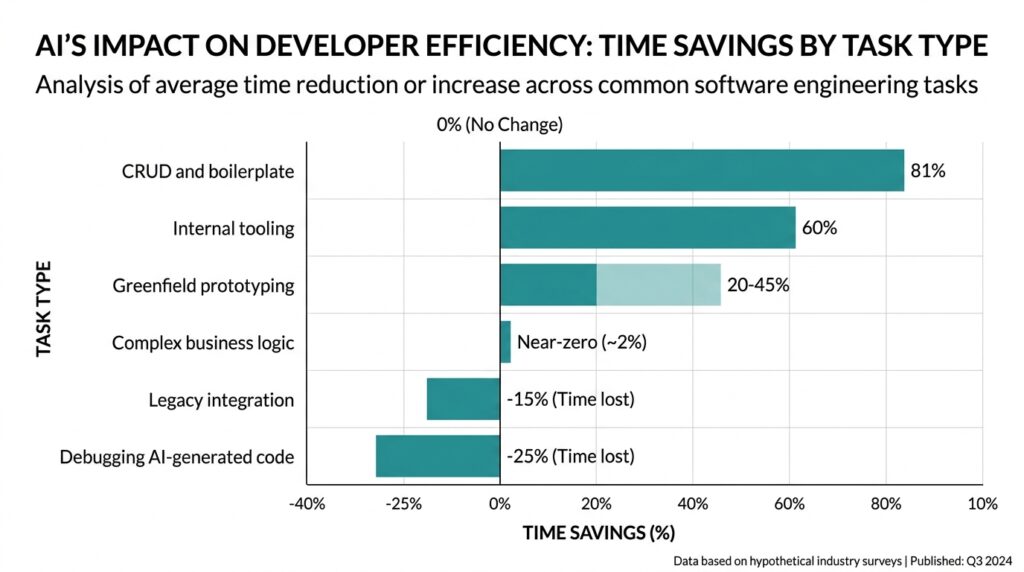
The AI coding tools developer productivity research in 2026 reads differently depending on which tasks you are measuring. Most coverage conflates very different work categories into a single headline number, which is why the figures seem contradictory across different sources. They are not contradictory. They are measuring different things.
Here is what the data actually says sorted by task type, drawing from the 13Labs,Keyhole Software, and Ortem Technologies research aggregates.
Tasks where vibe coding is genuinely transformative:
Boilerplate and CRUD operations show up to 81% time savings. Nobody misses writing repetitive endpoint handlers by hand. AI handles well-understood, structurally predictable patterns reliably and the speed advantage is not contested.
Greenfield prototyping and MVPs show 20% to 45% median task completion time reduction. When the cost of bugs is low, the feedback loop is short, and you are validating whether something is worth building at all, vibe coding compresses timelines by weeks and the speed advantage is real.
Internal tooling shows 60% reduction in development time according to IBM’s enterprise AI research cited by Hashnode’s 2026 state of vibe coding analysis. Internal tools have higher bug tolerance and lower security stakes, which removes the main failure modes.
Tasks where vibe coding shows little or negative net benefit:
Complex business logic with many dependencies shows 1.5x to 2x gains at best, often less, because the prompting and review overhead cuts into whatever time was saved on generation.
Debugging AI-generated code from a codebase you did not write takes longer than writing the code manually would have, according to every practitioner account that separates generation time from total delivery time.
Legacy system integration is the worst category. One missed constraint about how the legacy system actually behaves creates a cascade that the AI could not have known about and that takes longer to untangle than manual implementation would have required.
The net productivity figure that holds across enterprise deployments with strong review processes is 40% to 60% faster delivery, not the 74% or 81% figures that vendor marketing leads with. Those higher numbers are real for specific tasks in controlled conditions. They do not represent the typical production experience.
The Security Problem That Is Not Going Away
The vibe coding security risks 2026 data is the part of this conversation that enterprise teams need to stop treating as a future concern.
AI-generated code contains approximately 1.7 times more major issues and 2.74 times more security vulnerabilities than human-written code, per Ortem Technologies’ 2026 security audit analysis. The underlying reason is structural and worth understanding clearly: AI models optimize for code that compiles and appears to run correctly. Security vulnerabilities frequently involve edge cases, race conditions, privilege escalation paths, and input validation failures that do not surface in basic functional testing. An AI model generating code cannot anticipate what an attacker will do with that code in a production environment.
The problem is compounded by review behavior. 96% of developers do not fully trust AI-generated code according to Keyhole Software’s research. But only 48% always review it before committing. That gap between stated distrust and actual review practice is where vulnerabilities ship.
Gartner’s forecasts make the scale of this risk concrete: prompt-to-app approaches by teams without proper governance will increase software defects by 2,500% by 2028. That is not a rounding error of a forecast. That is Gartner saying the gap between vibe coding velocity and vibe coding governance is heading toward a defect crisis at enterprise scale.
For teams building on the MERN stack specifically, the vulnerability categories that show up most frequently in AI-generated Node.js code are SQL and NoSQL injection patterns, improper JWT validation, and missing input sanitization on React form handling. These are not exotic attack vectors. They are the ones that show up in entry-level OWASP Top 10 training. AI tools generate them because they generate functionally correct code that does not account for adversarial input.
The practice that closes this gap is not stopping vibe coding. It is treating AI-generated code exactly the way you would treat code from a fast but careless junior developer: review everything before merge, run static analysis scanning on every PR, and never ship AI-generated authentication or payment handling code without a senior eyes-on review regardless of how clean it looks.
The Senior-Junior Split That Changes What You Should Hire For
The vibe coding impact on software developers is not landing equally across experience levels, and the data on this should be reshaping how engineering teams think about hiring and career development.
Senior developers with ten or more years of experience report 81% productivity gains from AI tools, according to research published in Science and cited across multiple 2026 aggregates. The explanation is direct: experienced engineers can filter bad AI suggestions before running the code. They know what correct output looks like at a system level, which means they extract the speed benefit of AI generation while catching the errors that would otherwise cost debugging time later.
Junior developers show no measurable output improvement in the same research. In some cases they show negative net effects. The reason is identical to the senior finding but in reverse: developers who are still building their mental model of how systems work cannot reliably evaluate whether AI-generated output is correct, well-structured, or secure. They over-trust AI output and lose time debugging errors they accepted too quickly.
This creates a direct problem for the engineering talent pipeline that connects directly to why AI is narrowing the entry-level hiring gap in technology roles right now. Senior engineers became more valuable overnight when AI started writing the boilerplate work that junior developers used to learn from. The code that taught junior developers how systems actually work, through the process of writing it manually and debugging it when it failed, is now being generated by a tool that produces plausible-looking output without explaining its reasoning.
The practical implication for any engineering lead: vibe coding does not reduce the value of senior engineering judgment. It concentrates it. You need fewer people writing boilerplate and more people who can evaluate whether generated code is production-appropriate. That is not a junior developer skill in most cases, and the talent market in 2026 is reflecting that distinction in compensation data.
The Tools Actually Worth Using in 2026
A vibe coding discussion without tool recommendations is incomplete, so here is the honest version sorted by use case rather than by marketing narrative.
Cursor has established itself as the strongest general-purpose AI-native editor, with $1 billion in annualized revenue and a $29.3 billion valuation as of 2026. Multi-file editing, codebase context awareness, and the quality of inline suggestions on complex refactoring tasks make it the default choice for teams doing serious production development. The learning curve is real but it pays back within the first week for most developers.
Claude Code leads on autonomous software engineering tasks and produces the highest SWE-bench scores among current CLI tools. For complex multi-step engineering tasks where you want a model that can hold long context and reason through dependencies, it is currently the strongest option in its category. Understanding how Model Context Protocol connects Claude Code to your external tools and data sources is worth reading before setting up a serious Claude Code workflow, since the MCP integration layer is where most of the production-grade capability comes from.
GitHub Copilot at $10 per month remains the safest enterprise choice with 90% Fortune 100 adoption. It integrates cleanly into existing engineering workflows without requiring workflow redesign, which matters more than raw capability for teams with established review processes and compliance requirements.
Windsurf, acquired by OpenAI in 2025, delivers strong agentic IDE capability and is the strongest alternative to Cursor for teams that want agentic task execution built into the editor rather than accessed through a CLI.
The tool that gets underemphasized in most roundups: whatever automated security scanning tool your CI pipeline is currently missing. AI-generated code at 2.74x the vulnerability rate of human-written code means SAST scanning is no longer optional overhead. It is the verification layer that makes the entire vibe coding workflow safe to ship.
What Vibe Coding Actually Looks Like When It Works
The teams running AI-assisted coding successfully in production in 2026 share a specific set of practices that distinguish their outcomes from the SaaS-product-shutting-down story from the introduction.
They define architecture and system constraints before touching an AI tool for a new feature. The AI writes implementation code against a defined contract. It does not define the contract itself.
They track two delivery metrics separately: time to first working version and time from working version to production-ready. Vibe coding compresses the first. Without review discipline, it expands the second. Teams that measure only the first metric consistently overestimate their productivity gains.
They run automated testing and SAST scanning on every AI-generated PR without exception, not as a governance policy but as a practical necessity given what the vulnerability data shows.
They pair experienced engineers with AI tools and use those engineers to evaluate output rather than to write boilerplate. The boilerplate belongs to the AI. The judgment belongs to the senior engineer. Mixing those roles is where most of the documented failures come from.
The Keyhole Software case study framing is worth applying as a test for any AI coding deployment: did you use AI to speed up delivery, or did you use it to deliver production-ready systems? The first is a tool choice. The second is an architectural discipline. Most teams that are struggling with vibe coding results are doing the first while expecting the second.
Where Vibe Coding Goes From Here
The future of AI assisted coding in 2026 is not a question of whether to use it. That debate is over. 92% daily adoption across US developers is not a trend that reverses.
The question is whether the industry builds governance infrastructure at the same pace it builds velocity infrastructure. Gartner’s twin forecasts sit at the center of that question: 40% of new enterprise production software built via vibe coding techniques by 2028 coexists with a 2,500% increase in defects if governance does not keep up. Both are plausible. Which one your team experiences depends entirely on the review and verification practices you build now rather than after the first major production incident.
The next evolution is already visible in the agentic coding tools gaining adoption in 2026. Agents that navigate codebases, run tests, edit files across multiple repositories, and open pull requests semi-autonomously represent a step beyond code completion toward AI assistance across the full development lifecycle. The AG-UI Protocol that standardizes how AI agents communicate state to your frontend is one of the infrastructure pieces being built right now to support that transition.
The developers who will be best positioned in 2027 and 2028 are not the ones who used AI the most. They are the ones who developed the clearest judgment about when AI output can be trusted and when it needs human review before it touches a production system. That judgment is a skill. It does not come from the tools. The real skill is measuring two delivery timelines separately, how long until something works, and how long until it is safe to ship, and never confusing the subjective sensation of speed with what the clock actually recorded.
The METR finding is only unsettling if you ignore it. If you build your workflow around it, it is actually clarifying.
Conclusion
Vibe coding productivity in 2026 is genuinely positive for the specific categories of work it was designed to accelerate. It is genuinely negative for the specific categories it was not. The data is not ambiguous about which is which. What is ambiguous is whether most teams are applying it carefully enough to stay on the right side of that line.
The 19% slower finding and the 2.74x vulnerability rate are not arguments against AI-assisted coding. They are arguments for treating AI-generated code with the same rigor applied to any fast but inexperienced contributor: review everything, test automatically, and never ship authentication or payment logic without a senior engineer’s explicit sign-off regardless of how clean the AI output looks.
The teams winning with vibe coding productivity 2026 are not the ones trusting AI the most. The winning pattern is maximum generation speed paired with zero shortcuts on review. That combination is where the 40% to 60% net delivery gains live. Everything else is speed that accumulates as debt.