
Introduction
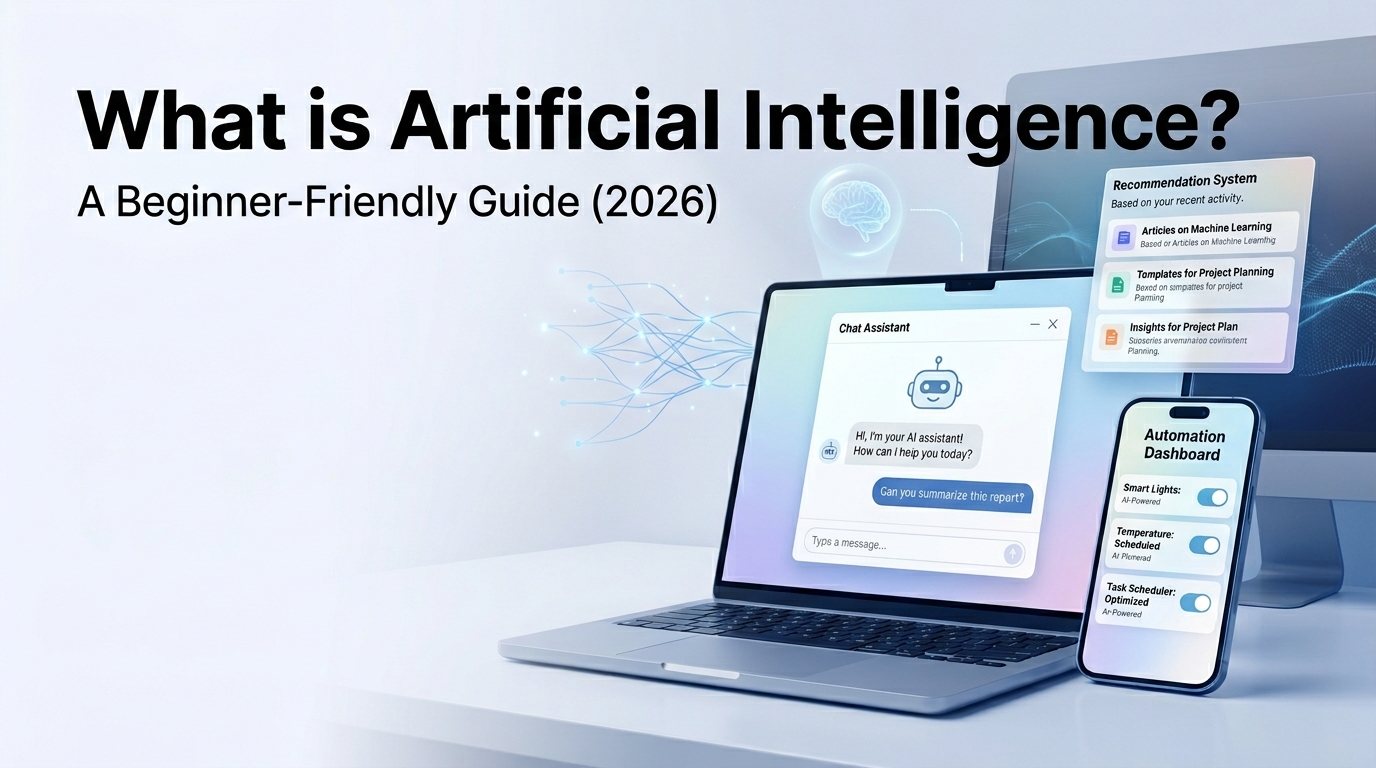
Artificial Intelligence (AI) is no longer a futuristic concept, it’s already transforming how we work, communicate, and make decisions every day.
From tools like ChatGPT to Netflix recommendations and Google Search, AI is deeply embedded in modern life. But with so much hype around it, one question still remains:
What exactly is artificial intelligence, and why does it matter to you?
In this beginner-friendly guide, you’ll learn:
- What AI is (in simple terms)
- How it works behind the scenes
- Real-world examples you already use
- And what AI means for your future
Table of Contents
What is Artificial Intelligence?
Artificial Intelligence is a branch of computer science focused on building systems that can perform tasks typically requiring human intelligence.
These tasks include:
- Understanding language
- Recognizing images
- Solving problems
- Making decisions
In simple terms:
AI allows machines to learn from data, think logically, and improve over time without explicit programming.
In Short (Quick Summary)
Artificial Intelligence is technology that enables machines to learn, adapt, and perform tasks like humans often faster and more efficiently.
Types of Artificial Intelligence
Understanding the types of AI helps you see where we are today and where we’re heading.
1. Narrow AI (Weak AI)
This is the most common form of AI today, designed for specific tasks.
Examples:
- ChatGPT for writing and conversations
- Google Maps for navigation
- Alexa and Siri for voice commands
These systems are powerful but limited to one function.
2. Artificial General Intelligence (AGI)
AGI refers to AI that can perform any intellectual task a human can.
This level of AI is still under development and hasn’t been achieved yet.
3. Super intelligent AI
A theoretical concept where AI surpasses human intelligence in all aspects.
Currently, this exists only in research and speculation.
How Does Artificial Intelligence Work?

At its core, AI works by analyzing large amounts of data and identifying patterns.
Key technologies behind AI:
- Machine Learning (ML)
AI learns from data without being explicitly programmed - Deep Learning
Uses neural networks to process complex information - Natural Language Processing (NLP)
Helps machines understand and generate human language
In simple terms:
The more data AI systems process, the smarter and more accurate they become over time.
A Simple Example
When you use Netflix, AI analyzes:
- What you watch
- How long you watch
- What you skip
Then it recommends content tailored specifically to you.
That’s AI learning from your behavior.
Real-World Applications of AI
AI is already powering tools and platforms you use daily:
- Search Engines (Google) → Smarter search results
- Streaming (Netflix, Spotify) → Personalized recommendations
- E-commerce (Amazon) → Product suggestions
- AI Assistants (ChatGPT, Alexa) → Content and automation
Benefits of Artificial Intelligence
AI is transforming how individuals and businesses operate:
- Automates repetitive tasks
- Saves time and increases productivity
- Improves decision-making with data
- Delivers personalized experiences
Challenges and Risks of AI
Despite its benefits, AI comes with challenges:
- Data privacy concerns
- Bias in algorithms
- Job displacement in certain industries
- Ethical concerns around misuse
Understanding these risks is just as important as understanding the technology itself.
The Future of Artificial Intelligence
AI is rapidly evolving and is expected to become a core part of every industry.
Key trends shaping the future:
- AI-powered automation in businesses
- Smarter personal assistants
- Growth of generative AI tools
- AI integration in healthcare and education
AI is shifting from a “nice-to-have” tool to essential infrastructure.
What This Means for You
AI is not just a tech trend, it’s a skill advantage.
- Students: Learning AI tools early gives you a competitive edge
- Professionals: AI can automate tasks and boost productivity
- Businesses: AI can reduce costs and improve efficiency
The sooner you understand and use AI, the better positioned you’ll be in the future.
Conclusion
Artificial Intelligence is shaping the future of how we live and work. While the technology may seem complex, understanding its basics can help you stay ahead in a rapidly changing world.
AI isn’t just the future,it’s already here. The question is: how will you use it?
FAQs
-
What is artificial intelligence in simple terms?
Artificial intelligence is technology that allows machines to perform tasks that usually require human intelligence, such as learning, problem-solving, and decision-making.
-
Is AI the same as machine learning?
No. Machine learning is a subset of AI that focuses on learning from data, while AI is the broader concept.
-
Where is AI used today?
AI is used in search engines, streaming platforms, chatbots, e-commerce, healthcare, and more.
-
Can AI replace human jobs?
AI may replace some repetitive jobs, but it also creates new opportunities and roles.