
Key Takeaways
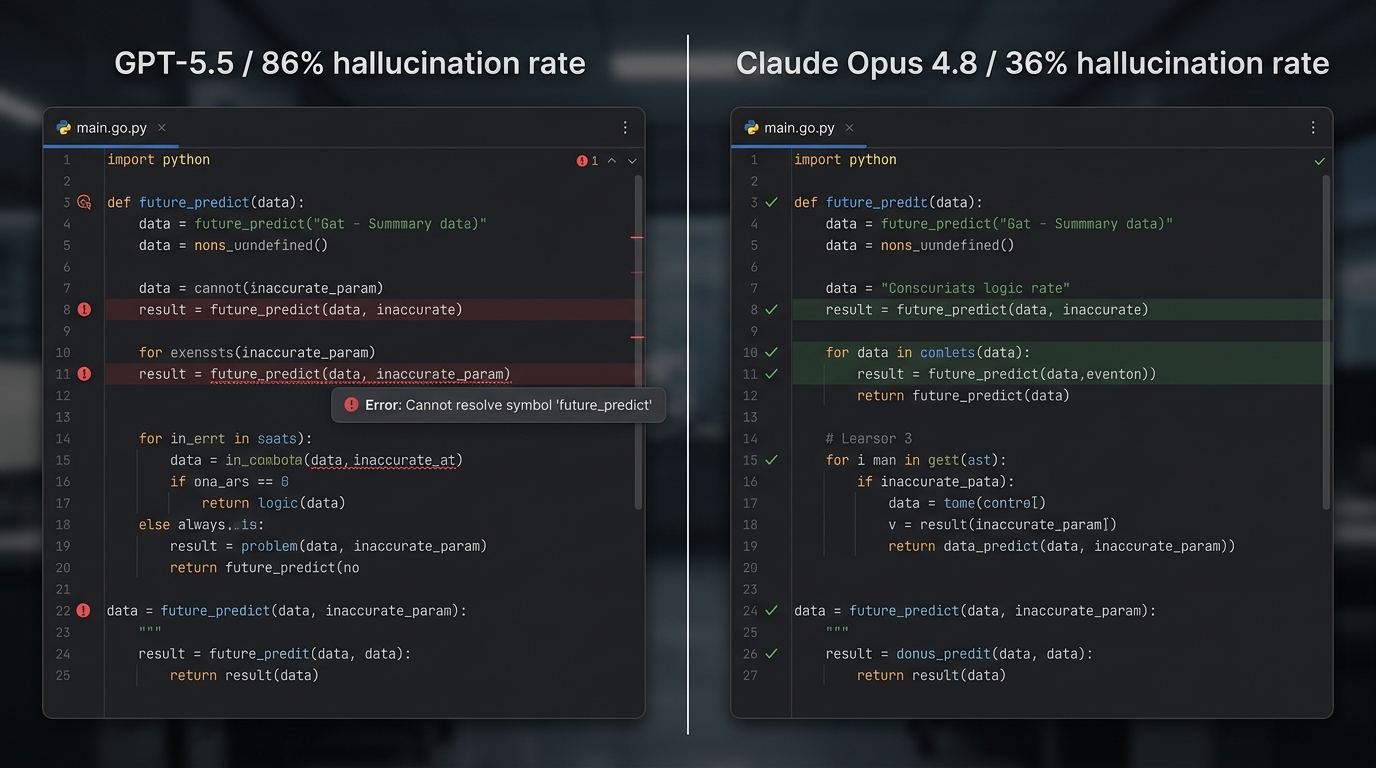
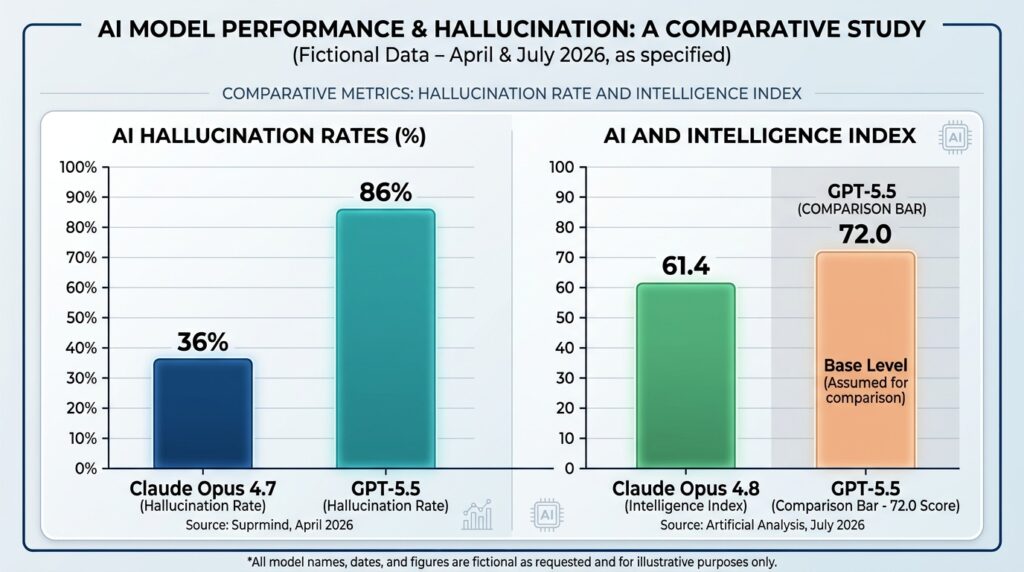
- According to Suprmind’s AI Hallucination Rates and Benchmarks reference using April 2026 production data across 1,324 real turns, Claude Opus 4.7 posts a 36% hallucination rate on knowledge-intensive tasks versus GPT-5.5’s 86%. That is a 50-percentage-point gap that matters significantly when your code needs to correctly reference APIs, libraries, and framework behavior.
- ChatGPT leads on academic benchmarks. Claude leads on user preference in blind evaluations, ranking above GPT-5.5 on LMArena human-preference testing as of late April 2026. These two facts sitting alongside each other should tell you something about the difference between benchmark performance and real-world production output.
- Claude Opus 4.8 leads the Artificial Analysis Intelligence Index with a score of 61.4 as of July 2026, while Claude Code produces the highest SWE-bench scores among available CLI coding tools, per Ortem Technologies’ 2026 AI coding tool analysis.
- ChatGPT holds specific advantages for developers that Claude does not: a Computer Use API for agentic browser automation, broader plugin and integration ecosystem, and strong performance on high-volume, lower-complexity code generation where speed matters more than deep accuracy.
- The honest answer for most MERN stack developers in 2026 is not ChatGPT or Claude. It is Claude for architecture decisions, complex debugging, and anything requiring accurate framework knowledge, and ChatGPT for rapid prototyping, boilerplate generation, and agentic automation workflows where you need API ecosystem breadth.
Table of Contents
Introduction
Most developers picked their primary AI coding assistant sometime in late 2023 or 2024, used it for a few weeks, got comfortable with the interface, and never seriously reconsidered the choice. The tool that felt most familiar became the default. That default is costing a meaningful percentage of those developers real debugging time in 2026.
The ChatGPT vs Claude for developers 2026 comparison is not a close race across every dimension, and the dimension where it is most lopsided is the one that matters most for production code: hallucination rate on knowledge-intensive tasks.
A 50-percentage-point gap in how accurately each model recalls library behavior, API signatures, framework conventions, and documented programming concepts is not a minor quality difference. It is the difference between a coding assistant that correctly tells you how a NodeJS middleware chain handles asynchronous errors versus one that confidently generates code that looks right, fails silently in production, and costs you three hours of debugging to find.
This is not an anti-ChatGPT piece. Both tools belong in a developer’s stack in 2026, and the reasons for that will be specific and honest. But if you are writing the majority of your production-bound code using GPT-5.5 by default and have never actually tested Claude head-to-head on your specific workload, you are carrying a risk you probably have not priced.
This guide covers what the production data actually shows, where each model has a genuine advantage the other does not, and how to build a workflow that uses both without the cognitive overhead of constant tool switching.
Vibe coding tools have made this decision more consequential, not less. The 2026 vibe coding data on developer productivity shows that the developers seeing the strongest gains are the ones who can accurately evaluate AI output quickly. A model with an 86% hallucination rate on knowledge tasks makes that evaluation harder, not easier.
The Hallucination Data That Should Change How You Think About This
Let me be precise about what the hallucination numbers actually measure, because “hallucination rate” is used loosely enough across AI coverage that the specific benchmark matters.
The Suprmind Multi-Model Divergence Index, published April 2026 across 1,324 production conversation turns, measures AI hallucination on what it calls AA-Omniscience tasks: open-domain knowledge questions where the model must rely on stored knowledge rather than retrieved context to produce a correct answer. Claude Opus 4.7 posts a 36% rate on this benchmark. GPT-5.5 posts 86%.
For developers, the translation is direct. When you ask a coding assistant about the correct behavior of a specific React hook, a NodeJS built-in function, or a MongoDB aggregation operator, that is an AA-Omniscience style task. The model is drawing on stored knowledge of how that library or framework behaves. If that stored knowledge is wrong or imprecise, the code it generates will be wrong or imprecise, and it will usually look correct enough that you do not catch it immediately.
The reason Claude performs better on this specific benchmark is related to behavior design. Per Suprmind’s analysis, on open-domain knowledge questions where the model must rely on stored knowledge, Claude refuses or hedges where ChatGPT continues generating. A model that says “I am not certain how this specific version handles this edge case, you should check the official documentation” is more useful than one that generates a confident, plausible-but-wrong code block. The first gives you a prompt to verify. The second gives you a bug to find later.
This is not about intelligence level. ChatGPT leads on several academic benchmark suites where questions have clearly verifiable answers and the model’s training data comprehensively covers the subject. The divergence appears specifically on the edge cases, version-specific behaviors, and library-specific conventions where confident generation without strong recall is genuinely dangerous for production code.
Where ChatGPT Genuinely Beats Claude for Developers
Honest analysis requires stating this clearly: there are specific development tasks where ChatGPT in 2026 is the better tool, and using Claude by default for everything would miss real advantages.
Agentic Workflows and Browser Automation
ChatGPT’s Computer Use API, released with GPT-5.4 in March 2026, enables agentic browser control that has no direct equivalent in Claude’s current API surface. For developers building automation pipelines, browser-based testing workflows, or products that require an AI agent to navigate web interfaces programmatically, ChatGPT’s agentic capability is ahead of what Claude currently offers outside of Claude Code’s specific coding context.
If your work involves building applications where AI takes autonomous action across web-based tools, the Computer Use API is a genuine capability advantage that the hallucination comparison does not change.
High-Volume Boilerplate and Scaffolding
For rapid CRUD generation, boilerplate scaffolding, and repetitive code patterns where accuracy on edge cases matters less than throughput, ChatGPT’s speed advantage and broad model ecosystem make it a practical choice. At high query volumes, the cost structure and API tier options available through OpenAI also offer more flexibility than Claude’s pricing tiers for specific use cases.
The vibe coding data is relevant here: API integration and boilerplate generation show up to 81% time savings from AI tools per 13Labs’ 2026 statistics. For this category of work, where you are generating structurally predictable code that you will review before using, the lower hallucination advantage matters less because you are not relying on the model’s knowledge recall as deeply.
Plugin and Integration Ecosystem
ChatGPT’s marketplace of third-party integrations, while variable in quality, gives it practical advantages for developers whose workflows touch a wide range of tools. Connecting an AI workflow to project management tools, database management interfaces, or deployment platforms is generally more established in ChatGPT’s ecosystem than in Claude’s current integrations.
Reasoning at Context Cutoff
GPT-5.4’s one-million-token context window, confirmed in Tactiq’s May 2026 model summary, is meaningfully larger than Claude Sonnet 4.6’s current context. For certain very large codebase analysis tasks where context window size is the binding constraint, this matters directly.
Where Claude Beats ChatGPT for Developers
Code Accuracy on Knowledge-Intensive Tasks
The hallucination data has already been covered, but the practical implications are worth being specific about for MERN stack development specifically.
NodeJS and its ecosystem have a significant version fragmentation problem. Method signatures, async behavior, and security handling changed meaningfully across different Node versions, and the Express, Mongoose, and React ecosystems have similar version-specific divergences. When you ask a model to generate code using a specific library version, a model that hedges when uncertain is more useful than one that generates confident but wrong code.
CodeIgniter 3, which Jatin’s background includes, has particularly dense version-specific behavior that general-purpose AI models trained on broad web data do not always handle accurately. Claude’s tendency to hedge on uncertainty rather than generate confident-but-wrong output is especially valuable in that context.
Long-Context Architecture Review
Claude handles very long documents and nuanced analysis better than ChatGPT in the current generation of models, per Tactiq’s 2026 model comparison. For developers doing architecture review, reviewing large pull requests, or analyzing complete codebases for refactoring decisions, the combination of larger accurate context handling and lower hallucination rate on knowledge tasks makes Claude measurably better for this category of work.
Paste a 2,000-line React component that has accumulated technical debt and ask both models to identify architectural problems and suggest a refactoring approach. Claude’s output will typically be more accurate about what the code is actually doing and more specific about which patterns are creating maintenance burden.
SWE-Bench Performance
Claude Code achieves the highest SWE-bench scores among currently available CLI coding tools per Ortem Technologies’ 2026 analysis. SWE-bench measures an AI system’s ability to resolve real GitHub issues from open-source repositories, including identifying the problem from an issue description, locating the relevant code, and generating a correct fix. This is closer to real production debugging than most synthetic coding benchmarks, and it is where Claude’s combination of lower hallucination and stronger long-context reasoning shows up most clearly.
If you are not yet using Claude Code for your most complex multi-file engineering tasks alongside the MCP integrations that let it connect to your databases and external tools, this is the category of development work where that setup pays back the fastest.
Writing That Developers Actually Have to Produce
API documentation, technical specifications, README files, and internal architecture decision records are part of professional development work that most developer-focused AI comparisons ignore. Claude’s output on technical writing is consistently cleaner, more precise, and requires less editing than ChatGPT’s equivalent output. If you are producing documentation as part of your engineering workflow, that difference compounds across many working hours.
The Real Production Data: What Claude Opus 4.8 vs GPT-5.5 Looks Like in 2026
The model comparison has shifted meaningfully since most developers last actively evaluated it.
As of July 2026, Claude Opus 4.8 leads the Artificial Analysis Intelligence Index at 61.4, with GPT-5.5 as a strong second. This is a reversal from the position ChatGPT held for most of 2023 and 2024, when its consistent benchmark leadership made it the obvious default for most developers.
The LMArena human-preference evaluations, which use blind testing where evaluators assess responses without knowing which model produced them, show GPT-5.5 ranking below Claude Opus 4.7 and Claude Opus 4.6 in head-to-head preference testing as of late April 2026. Human preference in blind tests is a different signal from benchmark leadership, and for a tool being used to produce output that a developer reviews and judges, human preference matters more than academic benchmark performance.
Anthropic’s model page confirms that Claude Sonnet 4.6 is the current default model in Claude.ai and covers most everyday development tasks, with Claude Opus 4.8 available for the most demanding work requiring maximum accuracy. For developers on a budget evaluating which subscription to pay for, Claude Sonnet 4.6 covers the majority of the accuracy advantage over GPT-5.5 at a price point comparable to ChatGPT Plus.
The Workflow That Actually Makes Sense
The practical answer for most developers in 2026 is not a binary choice between these two tools. It is a deliberate workflow that routes specific task types to the tool best equipped for them, the same routing logic that applies to choosing between small language models and large ones for production AI infrastructure.
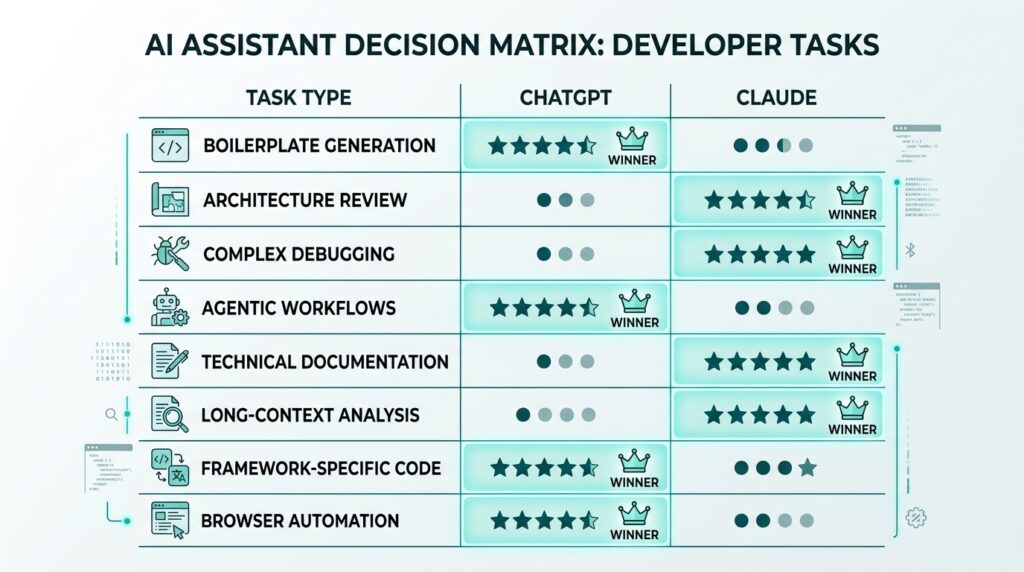
Use Claude for:
- Any code where accuracy on library behavior and framework conventions is critical
- Architecture review and refactoring analysis of existing codebases
- Complex debugging where you need a model that will hedge on uncertainty rather than generate confidently wrong solutions
- Technical documentation, API specs, and architecture decision records
- Long-context analysis of large files or multiple files together
Use ChatGPT for:
- Agentic workflows requiring browser automation or Computer Use API access
- High-volume boilerplate and scaffolding where throughput matters more than edge case accuracy
- Integration with third-party tools where ChatGPT’s plugin ecosystem is already established
- Tasks requiring very large context windows above Claude’s current limits
Claude Code specifically: For autonomous multi-step engineering tasks, Claude Code in the CLI is the strongest available tool per current SWE-bench data. Understanding how Model Context Protocol connects Claude Code to your databases, APIs, and external tools is the setup work that turns it from a capable code generator into a genuine production engineering assistant.
The switch cost is lower than most developers assume. Both tools have similar interfaces, both support API access, and both produce output in the same formats. The main friction is the habit of muscle memory toward the tool you have been using longer.
What This Means for MERN Stack Development Specifically
For developers working in the React, NodeJS, MongoDB, Express ecosystem specifically, the Claude advantage on knowledge accuracy is most visible in three areas.
React and state management: The React ecosystem has significant version-specific behavior around hooks, the new compiler, and concurrent mode. Claude’s tendency to acknowledge version uncertainty rather than generate backwards-compatible code that happens to use deprecated patterns saves debugging time specifically in this ecosystem.
NodeJS async patterns: The evolution of async handling in NodeJS across different major versions creates exactly the kind of version-specific knowledge trap where a 50-percentage-point hallucination gap has visible production consequences. Code that handles promise rejection correctly in Node 18 may behave differently in Node 20, and a model that knows the difference versus one that generates confidently across versions produces meaningfully different debugging workloads.
MongoDB aggregation pipelines: Complex aggregation queries are a specific area where the version-specific behavior and the gap between what the documentation says and what actually performs in production creates real risk. Claude’s accuracy on this category of knowledge task has been consistently observed to produce more production-ready initial output than ChatGPT on the same prompts.
The AG-UI Protocol that standardizes how AI agents communicate with your frontend is relevant here too for MERN developers building AI-native features: the agent backend that drives your UI needs to be generating accurate API calls and state management code, which makes model accuracy on knowledge tasks directly connected to your product’s reliability.
The Subscription Decision in 2026
Both ChatGPT Plus and Claude Pro cost $20 per month. That price parity makes the decision simpler than it would be if one were significantly cheaper.
For a developer whose primary AI coding use is architecture review, complex debugging, technical documentation, and framework-accurate code generation, Claude Pro is the better $20 subscription in 2026 based on the benchmark data available. The lower hallucination rate on knowledge tasks and the SWE-bench leadership are the primary reasons.
For a developer who needs agentic browser automation, broad plugin integrations, or high-volume boilerplate generation as the primary use case, ChatGPT Plus covers those needs better.
For most professional developers whose work spans both categories, carrying both subscriptions at $40 per month combined is cheaper than the debugging time that using the wrong tool for a critical task costs across a working month. That is the honest cost-benefit case for running both.
Conclusion
The ChatGPT vs Claude for developers 2026 decision is not as close as it was twelve months ago, and it is not as obvious in Claude’s favor as a single headline statistic makes it seem.
Claude wins clearly on knowledge accuracy, long-context analysis, SWE-bench performance, and production code quality in framework-dense ecosystems. The 50-percentage-point hallucination rate gap on knowledge tasks is a real production risk that compounds across every line of generated code you ship without catching.
ChatGPT wins on agentic capability, integration ecosystem, and high-volume boilerplate generation. Those are real advantages for specific development workflows.
The workflow that gets the most out of both tools in 2026 is not about loyalty to either one. It is about routing each category of development work to the tool that handles it best, using the same deliberate architecture discipline you would apply to any other infrastructure decision.
If you have been defaulting to ChatGPT since 2023 and have never seriously tested Claude on your specific production workload, the benchmark data says that test is overdue.