
Key Takeaways
- California has a dense cluster of AI app development companies, but “AI-powered” on an agency website does not tell you anything about actual technical depth.
- Before hiring an AI development partner, you need to evaluate their model integration approach, not just their portfolio screenshots.
- The questions that matter most are about inference infrastructure, API design, data handling, and how they approach prompt engineering at the application layer.
- A company that cannot explain the tradeoffs between fine-tuning and RAG (Retrieval-Augmented Generation) for your use case is probably not the right fit for a serious AI product.
- Cost overruns in AI app projects often come from underestimating API costs and infrastructure complexity, not from the development hours themselves.
Table of Contents
Introduction
If you search for an AI app development company in California right now, you will get hundreds of results. Agencies that pivoted to AI six months ago. Consultancies that added a ChatGPT integration page. Boutique shops that genuinely know what they are doing but look identical in a Google search to everyone else.
The problem is not that good companies do not exist. California, and Silicon Valley in particular, has some of the strongest AI engineering talent on the planet. The problem is that most evaluation guides for hiring a development partner were written for SaaS apps, not AI products. The criteria are completely different.
This article is for developers, technical co-founders, and engineering leads who are considering bringing in an external AI development partner and want to know exactly what to look for, what questions to ask, and what answers should send you running.
Why California Is Worth Paying Attention to for AI Development
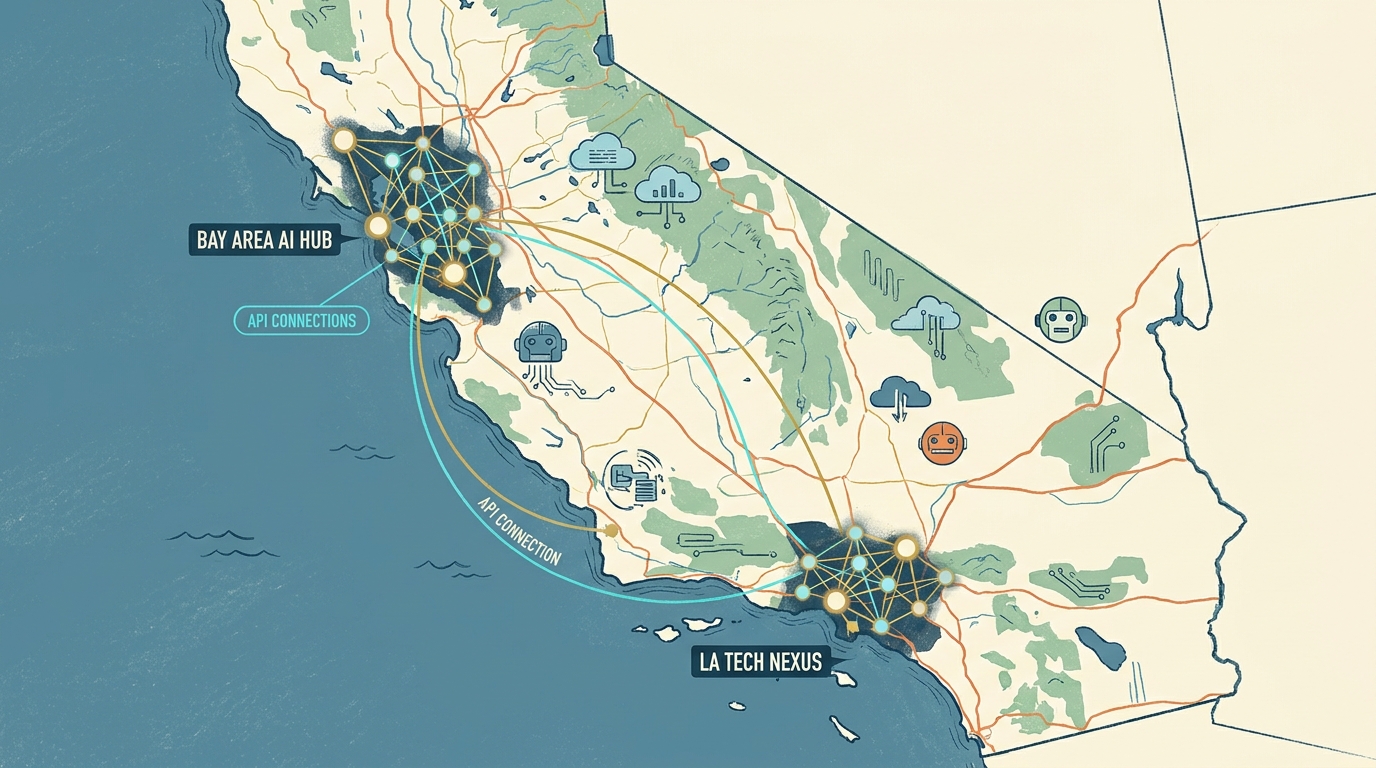
This is not just geography. California’s AI ecosystem, centered in San Francisco, the broader Bay Area, and increasingly in Los Angeles, has produced the infrastructure, the talent, and the research culture that the rest of the global AI industry runs on. OpenAI, Anthropic, Google DeepMind, and most of the foundational model labs are headquartered here. That concentration matters because it means the talent pool that feeds AI-focused development companies in California is unusually deep.
That does not mean every company calling itself an AI app development company in California has that depth. But it does mean the good ones have access to engineering talent, research context, and tooling ecosystems that are harder to find elsewhere.
For a technical founder evaluating options, the question is not whether California has good AI development shops. It clearly does. The question is how to tell them apart from the ones who just updated their website copy.
What an AI App Actually Requires vs. a Standard Web App
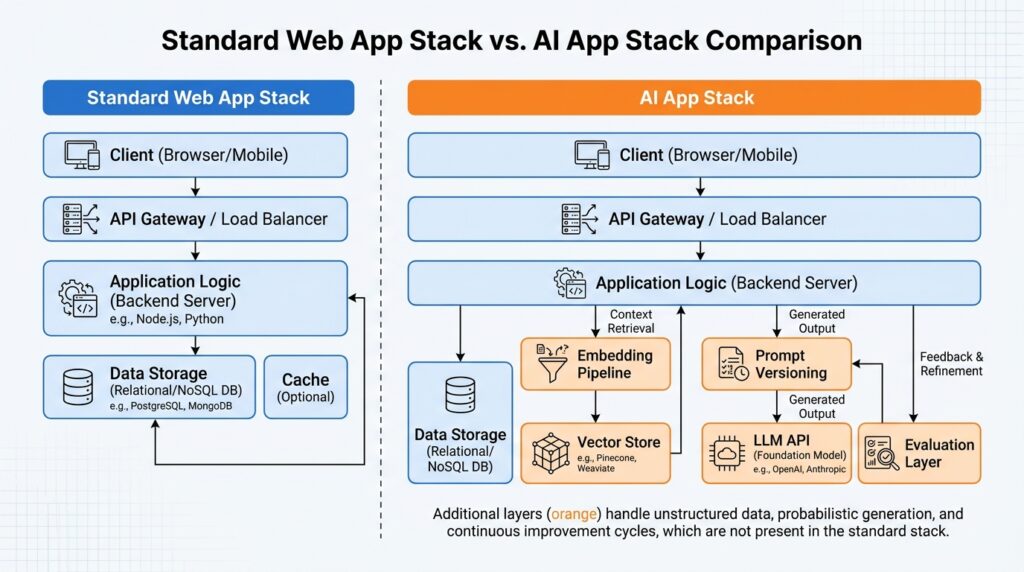
Before you can evaluate a development partner properly, it helps to be clear on what makes AI application development genuinely different from building a standard web or mobile app.
A standard MERN stack application has predictable behavior. You write a function, it does what the function says, you test it, you ship it. The complexity is in the engineering, but the components behave deterministically.
An AI application introduces several layers of non-determinism and infrastructure that most web development agencies have no experience managing:
- Model integration and versioning. When you build on top of an LLM API like OpenAI, Anthropic Claude, or Google Gemini, you are building on a dependency that can change behavior with a model update. Proper AI app development requires versioning strategies for prompts, model versions, and output validation.
- Prompt engineering at the application layer. A significant portion of AI app quality lives in how prompts are structured, chained, and managed. This is not something you bolt on at the end. It is architecture.
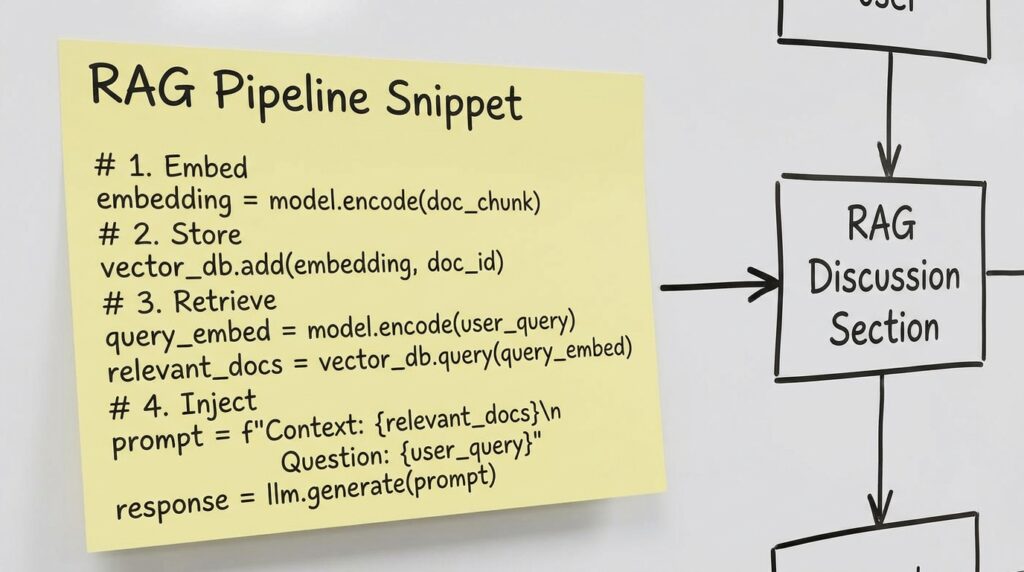
- RAG pipelines and vector search. Most production AI apps that need access to specific knowledge bases use Retrieval-Augmented Generation. This involves embedding models, vector databases like Pinecone, Weaviate, or pgvector, and chunking strategies for documents. A company that has never built a RAG pipeline is not ready to deliver a knowledge-intensive AI product.
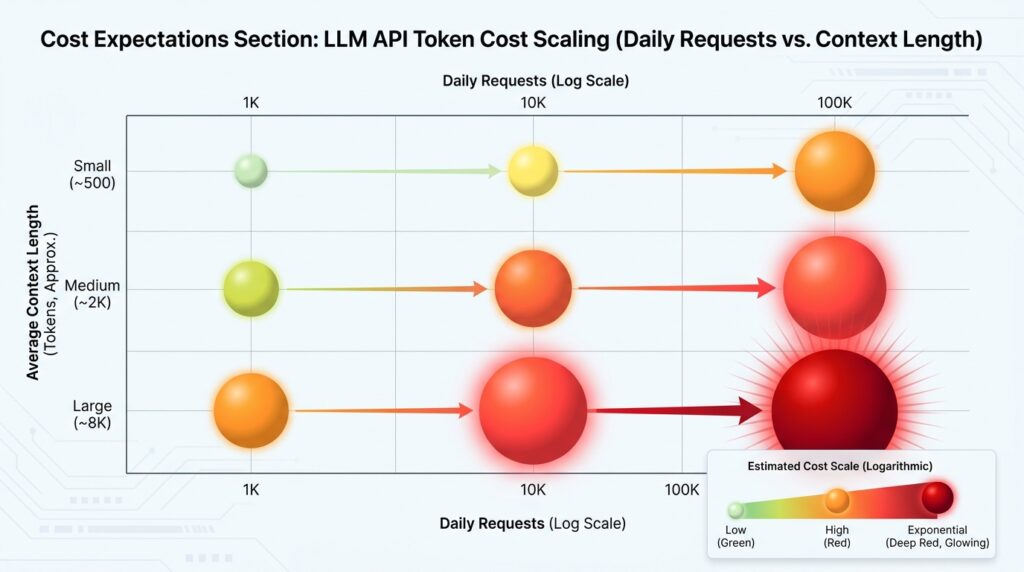
- Inference cost modeling. Token costs on LLM APIs add up fast at scale. A development partner that does not model inference costs as part of the technical architecture is going to hand you a product with an unpredictable operational cost.
- Evaluation and observability. How do you know if the AI feature is working? Logging, output evaluation frameworks, and A/B testing for prompt changes are critical for production AI. Tools like LangSmith and Helicone exist for exactly this. If your development partner has never used anything like them, that is a gap.
The Technical Questions You Should Ask Before Hiring
Here is a working list of questions to use when evaluating any AI app development company, regardless of where they are based. For California-based shops specifically, the competition is high enough that good companies should be able to answer all of these without hesitation.
1. What LLM providers do you have production experience with?
You are looking for specific names and context. OpenAI GPT-4o, Anthropic Claude, Mistral, Google Gemini, or open-source models via Ollama or vLLM. Bonus points if they have worked with multiple providers and can speak to the tradeoffs between them.
2. How do you handle prompt versioning and regression testing?
If they look confused by this question, the answer is they do not. Prompt engineering without version control is the equivalent of shipping code without Git.
3. What is your approach to AI evaluation and output quality monitoring in production?
You want to hear about logging pipelines, structured output validation, and ideally some form of systematic evaluation. LLM outputs are probabilistic. A good team has a plan for what happens when outputs degrade.
4. How do you decide between using a managed API versus a self-hosted or fine-tuned model?
This is a judgment and architecture question. The right answer depends entirely on your use case. But a developer who cannot walk through the tradeoffs between API-based inference, self-hosted open-source models, and fine-tuning is missing significant parts of the AI infrastructure picture.
5. How do you estimate and manage inference costs at scale?
They should be able to talk about token pricing, context window optimization, caching strategies for repeated prompts, and how API costs compound at volume. If cost modeling is not part of their pre-development planning, it will become part of your post-launch surprise.
6. Can you walk me through a RAG implementation you have shipped?
Ask for the specifics. What embedding model? What vector database? What chunking strategy? How did they handle document updates? Real experience leaves a specific paper trail of decisions made.
What the California AI Development Ecosystem Actually Looks Like
The AI development company landscape in California broadly breaks into four categories worth knowing:
- Large enterprise AI consultancies with hundreds of engineers, offices in San Francisco or LA, and case studies from Fortune 500 clients. Strong on delivery process and project management. Variable on actual AI depth, depending on which team you get assigned to.
- Mid-size specialist AI development shops that specifically focus on LLM-powered applications, AI product development, or specific verticals like healthcare AI, fintech AI, or enterprise automation. These are often the most technically current because AI is their entire focus, not one service line among many.
- Boutique AI development agencies with 5 to 25 engineers, often founded by engineers who came from the model labs or big tech AI teams. Technical depth can be exceptional. Delivery capacity and project management maturity varies significantly.
- Web/mobile agencies that added AI services after the ChatGPT wave. Range from genuinely upskilled teams to agencies that have wrapped a few OpenAI API calls in a nice demo. Portfolio scrutiny is essential here.
California’s startup ecosystem also means there are excellent independent AI engineering contractors and small teams who work on a project basis. For a technical founder with clear specs and enough internal bandwidth to manage the engagement, these can be the most cost-effective option.
Red Flags to Watch For in Proposals and Pitches
They lead with ChatGPT as the technology, not as one option. A serious AI development partner evaluates which model and architecture fits your use case. If the first answer to every AI question is “we will use ChatGPT,” that is a sign of shallow tooling familiarity.
No mention of data privacy or compliance. If you are building anything in healthcare, legal, finance, or any domain where user data is involved, your development partner should be raising questions about data residency, HIPAA compliance, or zero-data-retention API configurations without you having to prompt them. California has its own CCPA requirements that affect how AI apps handle personal data.
The demo is good but the technical architecture document does not exist. Demos can hide weak architecture. Ask for a technical specification or architecture overview before any contract is signed. How they document their thinking tells you a lot about how they will execute.
They cannot explain what happens when the API goes down. Production AI applications need fallback strategies. If your AI feature breaks completely every time there is an OpenAI incident, that is an architecture failure. Good teams build with service degradation, fallbacks, and caching in mind from the start.
Cost Expectations for AI App Development in California
California rates for experienced AI engineers are among the highest in the world. For a mid-size to senior AI development shop in the Bay Area or LA, expect:
- Hourly rates ranging from $150 to $300+ per hour for senior AI engineers
- Fixed-price AI product engagements for an MVP typically starting at $50,000 to $150,000 depending on scope
- Ongoing inference and API costs that are often underestimated in initial proposals
The persistent mistake in AI project budgeting is treating API costs like a minor line item. If your application processes significant user volume through an LLM API, token costs scale directly with usage. At 10,000 requests per day with an average context of 2,000 tokens, you are looking at meaningful monthly API spend that needs to be modeled into the product’s unit economics before you build.
A development partner that includes API cost projections in their proposal at different traffic tiers is demonstrating the kind of production experience that matters.
Trends Worth Knowing Before You Start This Search
The AI development agency market in California is maturing quickly, which has two effects. First, there are more genuinely skilled teams available than there were 18 months ago. Second, the gap between the best and the weakest is widening as the tooling complexity grows.
Multimodal AI application development is becoming a differentiating capability. If your product involves vision, audio processing, or document parsing alongside text, make sure your development partner has worked in those modalities specifically.
Agentic AI, where applications run multi-step autonomous workflows rather than single-turn LLM calls, is the direction product development is heading. Frameworks like LangGraph and CrewAI are moving into production use. A development company that has shipped agentic features, not just chatbots, is positioned for where AI apps are going over the next 12 months.
Conclusion
California genuinely has some of the best AI application development talent available anywhere. The challenge is not a shortage of options. It is knowing how to filter them.
The technical questions outlined in this guide are not designed to trip anyone up. They are designed to surface the difference between teams that have shipped real AI products and teams that have shipped good-looking demos. That difference matters enormously once you are dealing with production edge cases, scaling costs, and output quality at volume.
Start with the RAG and evaluation questions. If a company cannot give you a concrete, specific answer to both of those, keep looking. The ones who can are telling you they have done the actual work.
California’s AI ecosystem is strong enough that you should not have to compromise on technical depth. Take the time to find the team that earns the engagement on merit.