
Key Takeaways
- 82% of marketing teams now use generative AI daily in 2026, but the creators pulling ahead are not the ones with the most subscriptions. They are the ones with the sharpest workflows built around three to five deeply integrated tools.
- The AI content creation workflow has split into two camps: tool hoarders running 15 subscriptions with fragmented output, and disciplined creators running lean stacks with compounding results. One of these is winning.
- The real competitive gap in 2026 is not which tools you use. It is whether you have a coherent editorial strategy that AI executes, or whether AI is running your strategy for you.
- Video generation crossed a quality and cost threshold this year that makes it non-negotiable. High-definition text-to-video generation costs dropped 40% between 2025 and 2026. Any creator ignoring AI video is operating with a structural disadvantage.
- The tools worth paying for in 2026 are the ones that eliminate decisions, not the ones that create more of them.
Table of Contents
Introduction
Here is the uncomfortable opinion that most AI tool roundups will not give you: the majority of content creators using AI tools in 2026 are using them wrong.
Not because the tools are bad. Several of them are genuinely extraordinary. But because the framing most creators have adopted, which is that more tools equals better content, is producing the opposite of the intended result.
The best AI tools for content creators 2026 conversation has been hijacked by affiliate incentives and tool launches. Every new platform gets a breathless review. Every update gets a “game changer” headline. The result is a market where the average content creator is paying for eight to twelve subscriptions, switching contexts constantly, and producing work that is faster but not actually better.
This article takes a different position. The AI tools for marketers 2026 landscape is rich enough that you can build an extraordinarily capable production system on three to five tools if you choose the right ones and build deliberate workflows around them. Everything else is overhead.
Here is what actually works, what is genuinely worth paying for, and what you should ignore regardless of how many people are talking about it.
The Tool Hoarding Problem Nobody Talks About
Before getting into specific recommendations, this needs to be said clearly.
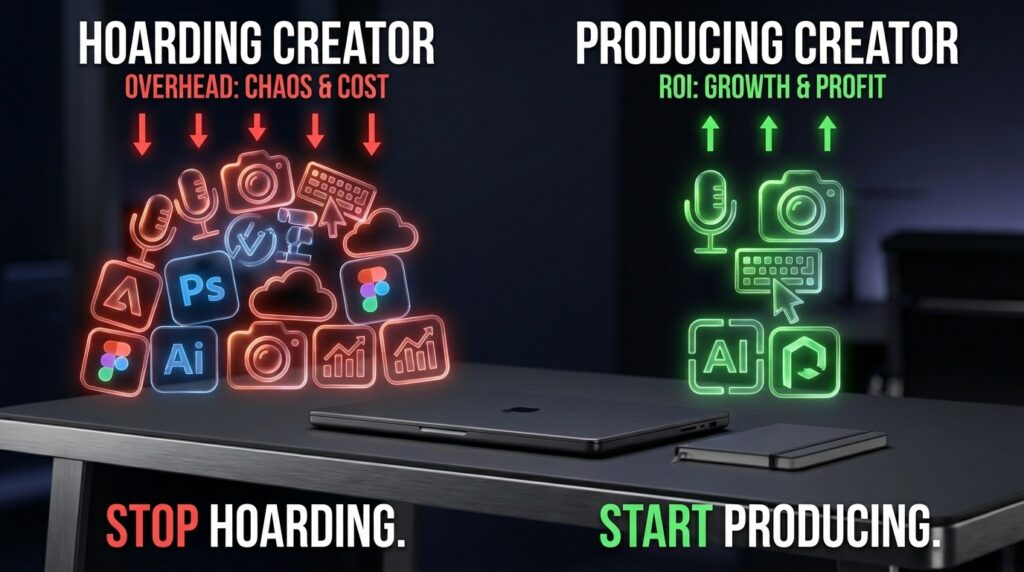
Context switching kills productivity. Native AI within your content management system saves an average of 2.5 hours weekly compared to standalone web apps. Most creators are losing those hours because they built a stack that requires them to move between five different browser tabs, three different login sessions, and four different output formats to produce a single piece of content.
The tool hoarding tendency is understandable. Content creation has never been more competitive, and 85% of marketers now use AI tools in their workflows, up from 61% just three years ago. When everyone around you is announcing a new tool they cannot live without, the anxiety of missing something genuinely useful is real.
But the creators consistently producing the best work in 2026 are the ones who resisted that anxiety. They picked a stack, learned it deeply, and built workflows that compound. The ROI of expertise in a smaller set of tools dramatically outperforms the ROI of surface-level familiarity with a large one.
With that principle stated, here is what the right stack actually looks like.
Writing and Long-Form Content: The Honest Comparison
The AI writing tools comparison most roundups give you is a feature list. The comparison you actually need is about which tool fits which purpose, because using the wrong one for the wrong job costs you more time than doing it manually.
Claude: The Best Long-Form Writing Partner Available
This is an opinion most roundups avoid because it conflicts with the affiliate incentives most sites have for recommending ChatGPT exclusively. But the evidence is consistent.
For long-form writing, including blog articles, in-depth guides, research-heavy content, and anything requiring sustained coherent argument across 1,500 words or more, Claude produces better output than any current alternative. The reasoning is more structured, the voice is more consistent over long contexts, and the tendency to pad with hollow filler sentences is significantly lower.
Claude by Anthropic is genuinely best for out-of-the-box natural long-form writing. That assessment matches real-world usage across professional writing contexts. If your primary content output is editorial articles, newsletters, or in-depth guides, Claude should be your first tool, not your backup.
ChatGPT: Still the Best Versatility Play
The case for ChatGPT in 2026 is not that it is the best at any individual writing task. It is that it is competent at an unusually wide range of tasks within a single interface.
ChatGPT remains one of the most versatile AI writing tools for content creators in 2026. It is widely used for brainstorming, outlining, drafting, rewriting, summarizing, scripting, and repurposing content across multiple platforms.
For creators who need a single tool that handles research conversations, content briefs, social captions, email drafts, and creative brainstorming without switching platforms, ChatGPT is still the right center of a content stack. Just stop using it for long-form editorial work where Claude consistently outperforms it.
Jasper and the Specialized Writing Tools: Situational, Not Essential
Jasper is a capable platform for teams that need brand voice enforcement and consistent tone across multiple writers or departments. It is best for on-brand marketing content at scale. That use case is real and valuable, specifically for marketing teams producing high volumes of campaign copy where voice consistency matters more than depth.
For solo creators and small teams, Jasper adds a subscription cost without adding meaningful capability beyond what Claude and ChatGPT already provide. It is worth considering at the agency or mid-market marketing team level. It is not a priority for individual creators building their first AI stack.
The opinion worth stating plainly: most AI writing tool subscriptions below the Claude and ChatGPT tier are redundant for the vast majority of content creators. Pick one, learn it deeply, and stop adding writing tools until you have genuinely hit the ceiling of what your primary one can do.
AI Video Generation: The Category That Changed Everything This Year
The AI video generation tools category in 2026 is not the same product class it was eighteen months ago. The quality threshold crossed in late 2025 means that AI-generated video is no longer distinguishable from human-produced video in many content formats. That changes the calculus for every creator making a choice about video production.
Runway: For Creators Who Want Full Production Control
Runway is the most capable general-purpose AI video creation and editing platform available. It offers AI-powered tools for video generation, background removal, motion tracking, and visual effects, and in 2026 it has become essential for YouTubers and video marketers who need cinematic quality without a full production team.
The honest caveat: Runway has a learning curve that most quick-start roundups understate. Getting genuinely good output requires understanding prompt structure for video generation, which is a different skill set from text prompting. Creators who invest the time to learn it properly get results that justify the learning curve. Creators who expect immediate usable output from day one will be disappointed.
HeyGen: The Strongest AI Avatar Platform for Creators
HeyGen has established a clear lead in AI avatar video production for content creators. It specializes in photorealistic AI avatar videos, a format that has grown dramatically for product explainers, training content, and international marketing, allowing creators to produce spokesperson content without a camera, studio, or on-screen talent.
The use case most creators underutilize with HeyGen: multilingual content. The same video asset can be rendered in multiple languages with lip-synced AI voice translation, turning a single English recording into a global content library. For any creator with an international audience or expansion ambition, this capability alone justifies the subscription.
Opus Clip: The Repurposing Tool That Pays for Itself
Opus Clip solves one of the biggest challenges in modern content strategy. It takes long-form video including YouTube episodes, webinars, interviews, and podcasts and automatically identifies the most engaging moments, clips them, adds captions, and formats them for social media. What once took hours of editing now takes minutes.
The opinion worth stating: if you are producing any long-form video content and not running it through Opus Clip or a direct equivalent, you are leaving a significant volume of distribution on the table. The repurposing workflow it enables, turning one 45-minute recording into twelve short-form clips formatted for three different platforms, is one of the highest-ROI applications of AI in content production right now.
Design and Visual Content: One Clear Winner and One Strong Opinion
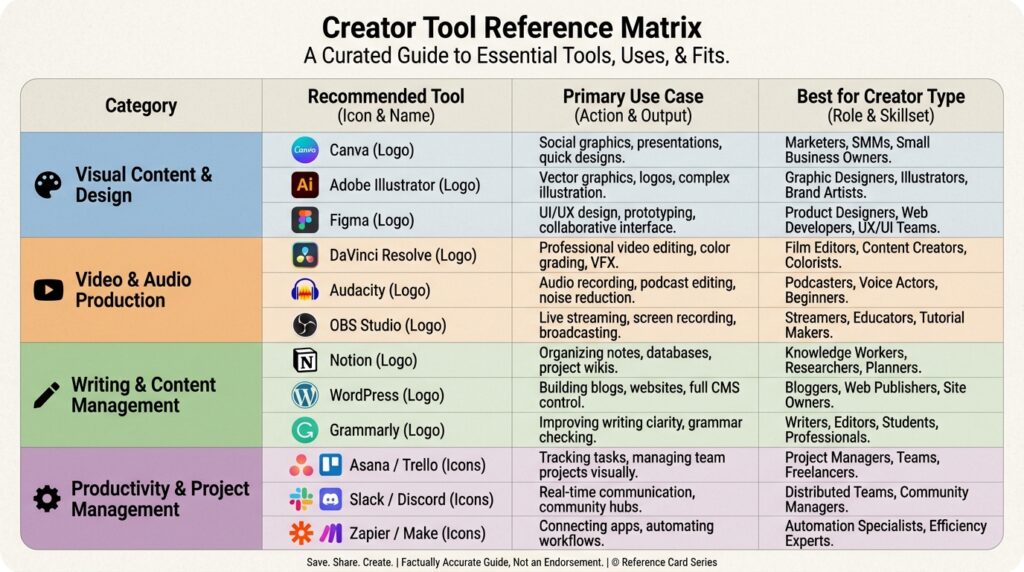
Canva AI: The Default for Non-Designers
Canva’s AI features have made it the dominant visual content tool for content creators who are not trained designers, and the gap between Canva AI and its competitors in this category has widened significantly in 2026.
Canva AI is best for non-designers who need prompt-to-publish design, which describes the majority of content creators building social assets, blog featured images, presentation decks, and email visuals. The integration of AI image generation, brand kit management, and direct publishing workflows inside a single platform is the practical embodiment of the integrated tools principle stated earlier.
Midjourney: When Quality Is Non-Negotiable
Midjourney remains the strongest AI image generation tool for creators who need high-quality original visuals for editorial, brand, or marketing use cases where Canva’s templates are insufficient.
The honest assessment: Midjourney requires more prompt skill than most of its competitors and does not have the workflow integrations that make Canva practical for day-to-day content production. It belongs in the stack of creators who produce visual-heavy content where image quality is a meaningful differentiator. It does not belong in every creator’s stack as a default recommendation, which is how most roundups position it.
Audio and Voice: ElevenLabs Has No Real Competition
For creators needing realistic AI voiceovers, audio narration, or voice cloning for video and podcast content, the gap between ElevenLabs and alternatives is wide enough that most roundups should stop comparing and just say so.
ElevenLabs produces voice output that is functionally indistinguishable from human recording in most content formats. For creators producing courses, explainer videos, YouTube narration, or podcast content who want AI voiceover quality without the uncanny valley problem that plagued earlier tools, ElevenLabs is the current standard.
This is another category where the opinion is worth stating plainly: this is not a competitive market for quality. Pick ElevenLabs, learn the voice customization features, and do not spend time evaluating alternatives unless cost is a specific constraint.
SEO and Research: The Overlooked Layer of the Creator Stack
The AI tools productivity creators conversation focuses heavily on content production. The research and optimization layer gets undervalued, which is a mistake because it is where the quality ceiling of your content is actually set.
Perplexity Pro: For Research That Does Not Waste Your Time
Perplexity Pro has become the research tool of choice for content creators who need cited, sourced information quickly without the citation fabrication problem that affects general-purpose LLMs used for research.
The practical workflow: use Perplexity for fact-gathering and source identification, then bring those inputs into Claude or ChatGPT for synthesis and drafting. This combination produces more factually grounded content than using a single tool for both research and writing, and it builds better citation hygiene into your production process.
AirOps: For Creators Ready to Build Real Content Pipelines
AirOps is best for automating sophisticated content pipelines and represents the next tier of AI content infrastructure beyond individual tool usage. It lets creators build multi-step automated workflows where research, brief generation, drafting, SEO optimization, and formatting all happen in sequence without manual handoffs.
The honest caveat: AirOps is not for creators in the early stages of building their AI stack. It requires a clear understanding of your own content workflow before automating it makes sense. Automating a poorly designed workflow produces bad content faster. It belongs in the stack of creators who have already established what good output looks like and want to scale it.
The Generative AI Content Tools Stack Worth Building in 2026
Here is the opinionated conclusion that most roundups avoid because it implies everything else on their list is optional.
The best content creators in 2026 do not run 15 AI subscriptions. They run three to five powerful, deeply integrated ones.
For a creator focused on written content, the right stack is Claude for long-form drafting, ChatGPT for versatility and brainstorming, and Perplexity for research. Three tools, clearly delineated purposes, minimal context switching.
For a creator focused on video, the right stack is HeyGen or Runway for production, Opus Clip for repurposing, and ElevenLabs for voiceover. Add Canva AI for thumbnails and social assets and the complete visual content workflow is covered at a fraction of what most creators are currently spending.
Integrated tools consistently win. 68% of creators now prefer AI built directly into their existing platforms over standalone web apps. The content creator AI stack that performs best is the one that minimizes the decisions required to produce output, not the one that maximizes optionality.
The AI tools ROI content marketing calculation is not just about the tools themselves. It is about the cost of context switching, the cognitive overhead of maintaining proficiency across too many platforms, and the quality loss that comes from divided workflow attention. The creators who have internalized this are producing better content on smaller budgets than the ones chasing every new launch.
What AI Cannot Do for You and Why That Matters More Than Ever
The strongest opinion in this entire guide is this one: the rise of generative AI content tools has made human editorial judgment more valuable, not less.
When every creator has access to the same tools, the differentiator is not capability. It is the quality of the brief, the sharpness of the angle, the depth of the research context, and the editorial instinct that decides what is worth saying. AI executes those decisions. It does not make them.
The AI content creation cost 2026 story is remarkable. Production costs have collapsed. Distribution has never been cheaper. But the market for undifferentiated content has also collapsed alongside it. The same tools that make it easy to produce content at scale make it impossible to compete on volume alone.
The creators winning right now are the ones who treat AI as production infrastructure and invest the time they save into developing sharper ideas, more specific expertise, and more distinctive editorial voices. That combination, human strategic thinking executed by AI production capability, is where durable content advantages live in 2026.
Conclusion
The best AI tools for content creators 2026 are not the newest ones or the most talked-about ones. They are the ones that fit your specific content workflow, integrate with each other cleanly, and eliminate the decisions that slow production without eliminating the judgment that determines quality.
Stop building a stack based on what everyone else is recommending. Build one based on an honest assessment of where your production bottlenecks actually are, then find the tool that removes that specific constraint.
Claude for deep writing. ChatGPT for versatility. Runway or HeyGen for video. Opus Clip for repurposing. ElevenLabs for voice. Perplexity for research. Canva AI for design. That is the complete toolkit for most content creators in 2026. Everything else is noise until you have genuinely exhausted what these can do.
The competitive advantage in content is not going to the creator with the most tools. It is going to the one with the clearest thinking about how to use a few of them exceptionally well.