
Key Takeaways
- The mass AI layoff narrative is wrong. According to the Anthropic Labor Market Impact Study published March 5, 2026 by economists Maxim Massenkoff and Peter McCrory, there is no detectable increase in aggregate unemployment for workers in AI-exposed occupations.
- But buried inside that reassuring headline is a specific finding that should alarm anyone entering the workforce: job-finding rates for young workers aged 22 to 25 in AI-exposed fields have fallen roughly 14% relative to 2022 levels.
- According to the NACE Job Outlook 2026 Spring Update, demand for AI skills in entry-level roles nearly tripled between Fall 2025 and Spring 2026. The jobs are not disappearing. They are being upgraded beyond reach of people who do not have those skills yet.
- The International AI Safety Report 2026 confirms that employment in AI-exposed roles has declined for younger workers while holding steady or rising for older ones. AI is not an equal-opportunity disruptor. It is hitting the bottom of the career ladder specifically.
- The most dangerous thing about this shift is how invisible it is. Nobody gets a termination letter. Companies simply stop opening entry-level positions. The data does not show up in unemployment figures. It shows up in graduates who cannot get their first job.
Table of Contents
Introduction
Every few months a new headline arrives declaring that AI is about to destroy millions of jobs. Then the aggregate unemployment numbers come out and they look fine. Pundits declare the fear overblown. Everyone moves on.
This cycle is obscuring something real and specific that deserves a much sharper look.
The AI impact on entry level jobs 2026 is not appearing in mass layoff announcements. It is appearing in hiring freezes, in entry-level job postings that require two to three years of experience, in graduates sending hundreds of applications and receiving nothing back. The AI job displacement statistics that matter most right now are not in the unemployment rate. They are in the hiring rate, and specifically in who companies are choosing not to hire at all.
This article makes a direct argument: the AI jobs disruption is not coming for your current position first. It is coming for the position you were supposed to hold five years ago to qualify for your current one. That is a structural problem disguised as a non-event, and it will take years to reverse once the scale of it becomes undeniable.
What the 2026 Research Actually Says: The Calm Surface and the Rip Current Underneath
Start with the good news, because it is real.
The most rigorous study of AI’s actual labor market impact published in 2026 found no apocalypse. The Anthropic Labor Market Impact Study, authored by economists Maxim Massenkoff and Peter McCrory and published on March 5, 2026, analyzed actual AI usage data against labor market outcomes. Its central finding: there is no systematic increase in unemployment for workers in the most AI-exposed occupations since ChatGPT launched in late 2022.
A separate analysis of Denmark by economists Humlum and Vestergaard, covering AI tool adoption across 25,000 employees and 7,000 firms through 2023 and 2024, found no significant impact on wages or hours worked. The Stanford AI Index 2026 similarly reports that large-scale aggregate job losses have not yet materialized in overall employment data.
For people already in the workforce, particularly those with specialized skills and accumulated expertise, the evidence genuinely supports relative calm. The feared displacement of experienced workers has not materialized at scale.
Now the bad news.
The 14% Finding Nobody Is Talking About
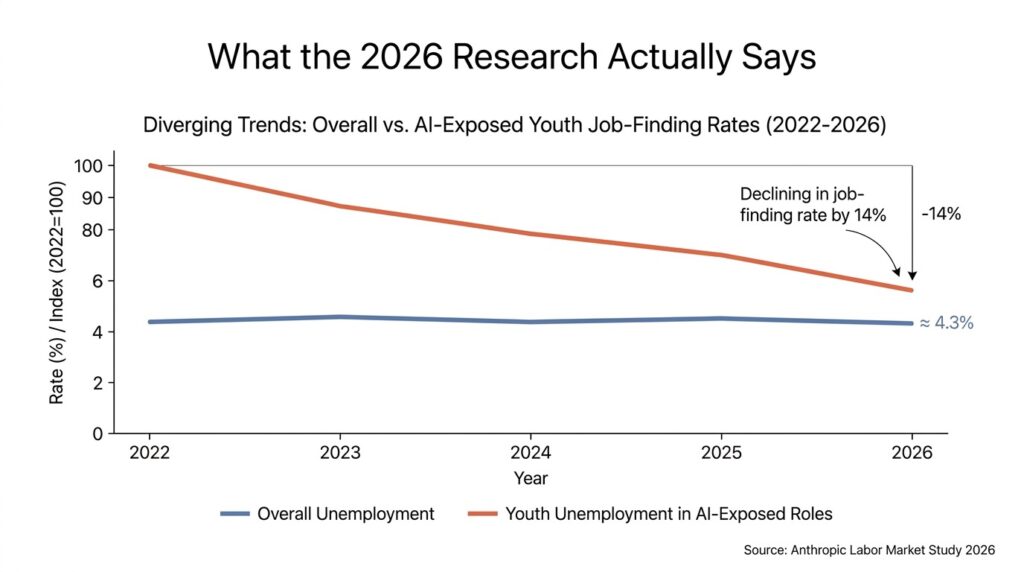
Buried inside the same Anthropic research paper that delivered the reassuring headline is a specific finding that changes the picture entirely.
Job-finding rates for young workers aged 22 to 25 entering AI-exposed occupations have fallen by approximately 14% relative to 2022 levels. The unemployment rate for this group did not spike. The unemployment rate stays flat because these workers are not being counted as unemployed in AI-exposed fields. They are simply not getting in.
The AI labor market shock may not begin with mass layoffs. It may begin with a closed door.
The International AI Safety Report 2026, a government-backed international research effort, reaches the same conclusion from different data. Employment in AI-exposed jobs in the US has declined for younger workers but either held steady or has risen for older workers since the release of ChatGPT. In the UK, firms with high AI exposure have slowed new hiring particularly for junior positions.
Two independent research streams, one from an AI company studying its own product’s labor effects, one from an international government safety body, arriving at the same specific finding: AI is not hitting the workforce uniformly. It is hitting young people trying to enter it.
Why Entry-Level Work Was Always the Most Vulnerable Layer
Understanding why this is happening requires understanding what entry-level work actually does in an organization, because most coverage of AI and jobs treats all work as interchangeable.
Historically, entry-level jobs consisted largely of tasks that were repetitive, rule-based, and process-heavy: data entry, basic code generation, summarizing meetings, drafting standard communications, and preliminary research. These tasks served a dual economic function: they provided necessary, albeit low-value, output for the firm.
This is precisely the task category that generative AI handles most competently and most cost-effectively. Summarizing a document. Drafting a first version of a report. Processing structured data. Writing a standard client communication. These are not tasks that require deep expertise or accumulated organizational knowledge. They are tasks that require time, attention, and basic competence, which are the specific assets a junior employee brings.
When a language model can produce a competent first draft in thirty seconds, the economic justification for hiring a junior employee to produce that first draft over two hours weakens considerably. Not because the junior employee is bad at the job. Because the economics of that specific task have been restructured around them.
The Missing Rung Problem
There is a concept that has been gaining traction in workforce research circles: the missing rung.
The whole concept of entry-level is now a misnomer. Postings now routinely demand two to three years of experience, creating a paradox where you need the job to get the job.
The career ladder in most knowledge work industries was built on a specific logic: companies hired people with potential, gave them low-stakes routine work to build familiarity and demonstrate judgment, and promoted the ones who showed the right qualities. Entry-level work was the intake mechanism for the entire talent pipeline.
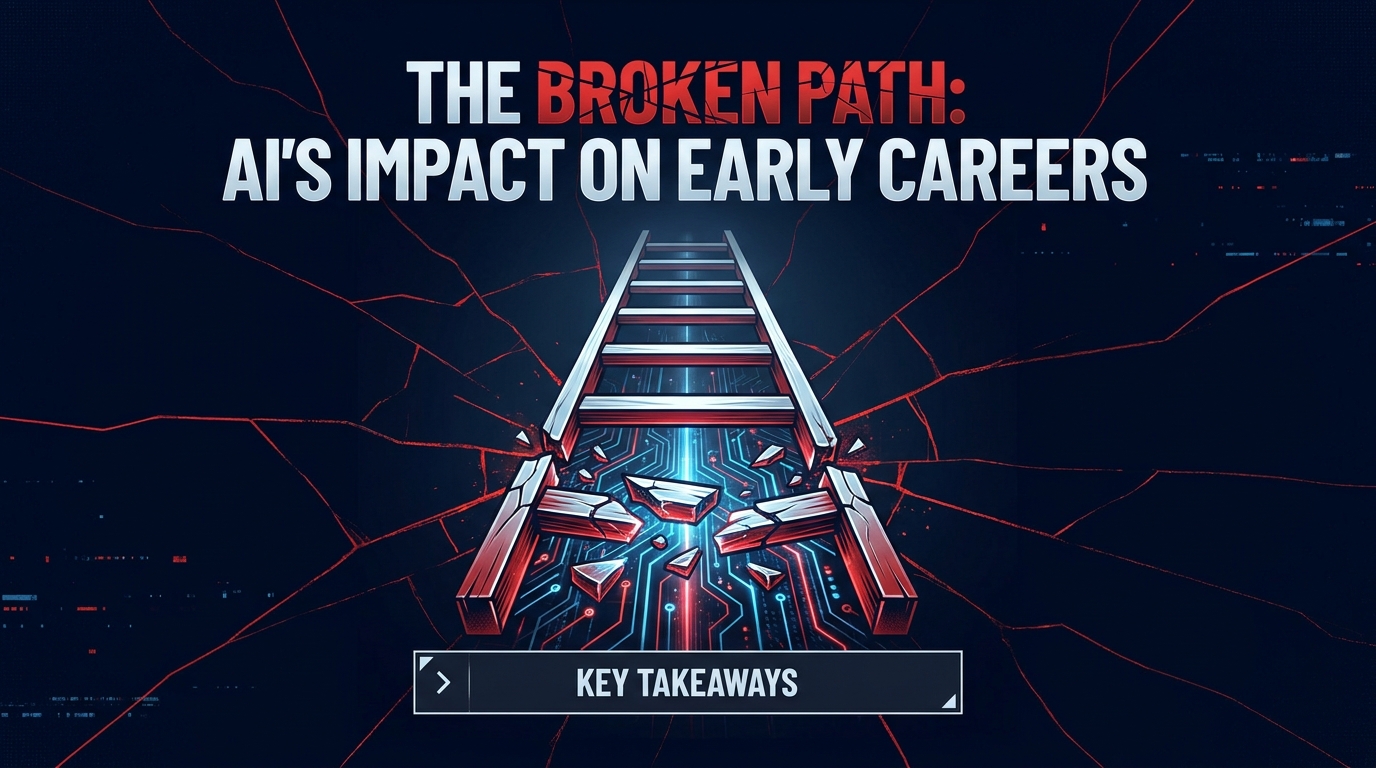
When AI handles the routine work, that intake mechanism breaks. Companies do not need as many people to do the routine work. They still need the senior judgment. But they have fewer reasons to hire people at the bottom and develop them toward it. The ladder stays standing but loses its bottom rung.
This is the AI and career ladder dynamic that aggregate unemployment figures are structurally unable to detect, because people who never got hired do not show up in unemployment counts.
The Sectors Where the Door Is Closing Fastest
The AI workforce disruption 2026 is not landing equally across industries. The entry-level squeeze is most visible in specific sectors.
Technology and Software Development
Junior developer roles were among the first to feel the structural pressure. Demand for freelance work using substitutable skills such as writing and translation decreased sharply after the release of ChatGPT, but demand for machine learning programming increased by 24%.
The implication is direct: the entry-level work that junior developers traditionally did, writing boilerplate code, handling basic feature implementations, fixing small bugs, is increasingly covered by AI coding assistants. What companies still need from human developers is the judgment to evaluate, direct, and integrate AI output. That is a mid-to-senior level capability, not a junior one.
Content, Writing, and Media
One study found that four months after ChatGPT was released, writing jobs on one online labor platform declined by 2% and writers’ monthly earnings fell by 5.2%.
That measurement covers a narrow window. The cumulative effect over three years of widespread generative AI adoption in content workflows is significantly larger than a two percent decline in the first four months. Entry-level content roles, junior copywriters, content coordinators, editorial assistants, have contracted sharply at companies that have adopted AI writing tools at scale.
Finance, Legal, and Consulting
The junior analyst and first-year associate roles at financial firms, law firms, and consulting practices were built almost entirely around high-volume research, document review, and structured data analysis. These are precisely the tasks that AI systems now handle with high competency at a fraction of the cost. According to a September 2025 survey by Resume.org of 1,000 US business leaders, 37% expect to have replaced jobs with AI by end of 2026, with 58% believing layoffs are likely in 2026.
The displacement in these sectors is not coming primarily from firing existing employees. It is coming from not opening new positions when experienced staff depart.
The Youth Unemployment Data That Puts Numbers on the Problem
Macro unemployment figures are the wrong measurement instrument for this problem. But the youth-specific data tells a different story.
The overall US unemployment rate in January 2026 was 4.3%. For younger workers aged 16 to 24, it was 9.4%. That gap between overall unemployment and youth unemployment has always existed, but the structural factors driving it are shifting. The traditional explanation, that young workers lack experience, is being reinforced by AI tools that reduce the incentive for companies to hire people specifically to build that experience.
Employers project a 1.6% increase in hiring for the Class of 2026 compared to the Class of 2025, according to research by the National Association of Colleges and Employers. In a labor market where the graduate population is growing and the number of roles requiring genuinely entry-level capability is shrinking, a 1.6% increase in projected hiring is functionally a decrease in opportunity per graduate.
The picture is not catastrophe. It is compression. The entry-level job market is becoming smaller relative to the number of people who need it, and the people who do get in are increasingly the ones who can already demonstrate AI proficiency before they start.
The AI Skills Paradox: You Need the Job to Learn the Skills You Need to Get the Job
This is where the AI skills for early career workers problem becomes genuinely circular.
According to the NACE Job Outlook 2026 Spring Update, AI is increasingly becoming an expectation for early career talent, shaping both the job market and entry-level work. Demand for AI skills in entry-level job postings nearly tripled between Fall 2025 and Spring 2026.
Companies are not removing entry-level positions and replacing them with nothing. They are rebuilding those positions around AI tool proficiency and expecting candidates to arrive with that proficiency already developed. The entry-level worker of 2026 is expected to be a capable AI tool operator from day one, reducing the margin for the on-the-job learning that entry-level roles traditionally accommodated.
The paradox: the workers who need entry-level jobs to develop professional skills are being screened for skills that typically develop in professional settings. The entry point requires the experience it was supposed to provide.
Professionals with specialized AI skills now command salaries up to 56% higher than peers in identical roles without those skills, according to data from DemandSage. The AI skills premium is real and growing. But it is most accessible to workers who already have professional contexts in which to develop and demonstrate those skills. For graduates entering the workforce for the first time, that premium sits behind a door they cannot yet open.
What the Remote Work Complication Adds
The AI narrative is not the only force reshaping entry level hiring decline 2026, and honest analysis requires acknowledging the complexity.
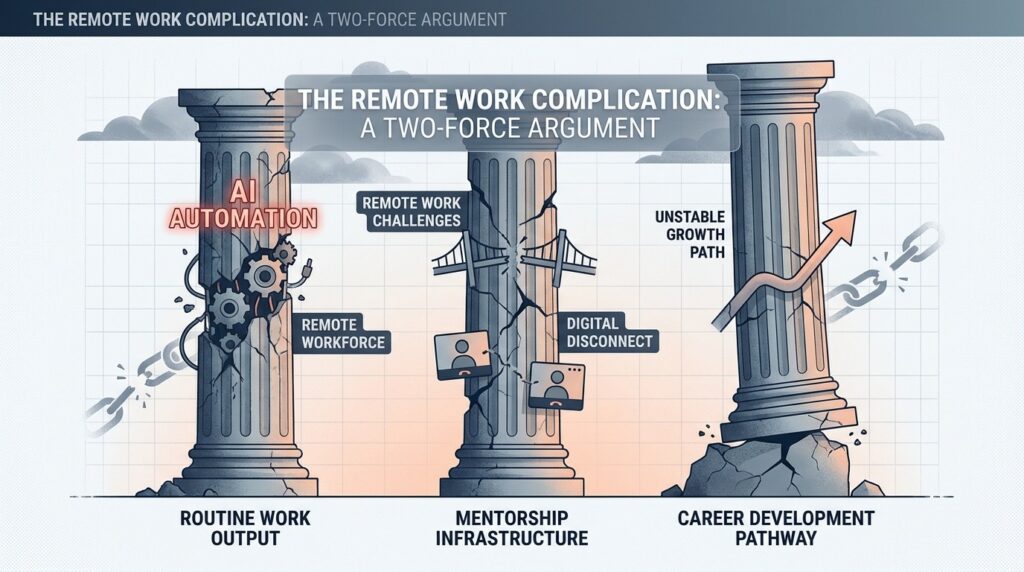
A new 2026 study found that remote work, rather than AI, is the strongest single factor behind declining hiring of junior employees. Entry-level workers lose valuable opportunities for mentorship, skill-building, and workplace learning when jobs are conducted remotely.
This finding does not contradict the AI story. It adds a second structural force to it. Remote work reduces the mentorship infrastructure that justified hiring someone without experience and developing them over time. AI reduces the volume of routine work that gave junior employees something productive to do while that mentorship was happening. Both forces are compressing entry-level opportunity simultaneously.
The implication for young workers is direct: the combination of AI and remote work is dismantling two of the three pillars that made entry-level hiring make sense for companies. Routine work output, handled by AI. Development infrastructure, weakened by remote arrangements. What remains is potential, which is harder to evaluate, harder to develop, and harder to justify paying for in a cost-conscious hiring environment.
What Young Workers Should Actually Do With This Information
The AI job market young workers reality in 2026 is not a reason for paralysis. It is a reason for a specific strategic response.
The workers who are navigating this environment successfully share a common characteristic: they are not competing with AI for the routine work. They are positioning themselves as capable directors of AI output, the people who know what good looks like, who can evaluate what the model produced, improve it, and take responsibility for the result.
That positioning requires demonstrating AI tool competency before entering the job market, not as a nice-to-have credential but as a baseline expectation. Familiarity with tools relevant to your specific field matters more than general awareness. A marketing candidate who has run actual campaigns using AI tools and can speak specifically to output quality and workflow design is a meaningfully different candidate from one who has simply used ChatGPT to write essays.
A new model is forming around what researchers are calling AI apprenticeships and superagency, a trend where junior workers use AI to bypass the skills gap and perform at mid-level capacity from earlier in their careers. The entry-level workers gaining traction in 2026 are the ones who figured out how to produce mid-level output by combining their energy and curiosity with AI tool proficiency. That combination is genuinely valuable and genuinely difficult to replace.
The workers struggling are the ones waiting for the market to return to what it was. It will not. The future of entry level work is not the absence of AI tools. It is deep integration with them from the first day.
What Companies Are Getting Wrong About This
The closing of entry-level access is not purely bad for companies, even though it looks efficient in the short term. The pipeline of experienced workers in five years depends on the entry-level hires of today.
AI may compress or bypass entry-level positions, leading to fewer junior jobs and potentially weakening the talent pipeline across the economy. Companies optimizing their headcount by eliminating junior roles are borrowing against a future in which they have fewer internally developed mid-level candidates and more expensive competition for external senior hires.
The organizations that will be best positioned in 2028 and 2029 are the ones that figured out how to maintain entry-level talent pipelines, even as the specific task content of those roles changes around AI capabilities. That requires rethinking what junior employees are for, not eliminating them because their original tasks have been automated.
Microsoft’s chief product officer for AI, Aparna Chennapragada, sees 2026 as a new era of alliances between technology and people. The future is not about replacing humans. It is about amplifying them. That principle is more obviously true at the senior level where human judgment compounds clearly with AI capability. Applying it at the entry level requires deliberate organizational design, not just good intentions.
Conclusion
The AI jobs story that dominates headlines is the wrong story. Mass unemployment has not arrived and the data does not support the prediction that it is imminent for most established workers.
The right story is more specific and harder to reverse. The AI job market fresh graduates reality in 2026 is a 14% decline in job-finding rates for young workers entering AI-exposed fields, youth unemployment running at more than double the national average, entry-level postings requiring experience that can only come from entry-level positions, and an AI skills expectation that arrived before the infrastructure to develop those skills in educational settings.
Nobody is getting fired in dramatic numbers. Nobody is getting hired in the numbers that a growing graduate population needs. That gap between the reassuring aggregate data and the specific lived experience of people trying to start careers is where the real AI jobs disruption lives in 2026.
The response for young workers is clear and urgent: stop waiting for the market to simplify, start building demonstrable AI tool proficiency specific to your target field, and position yourself not as someone competing with AI for routine work but as someone who can make AI output better than it starts.
The ladder has not disappeared. But the bottom rung has moved up. The workers who adapt to that reality now will be the ones in the best position when the companies that eliminated their pipelines realize what they gave up.