
Key Takeaways
- OpenAI shut down its own AI text classifier on 20 July 2023 for low accuracy. It had wrongly labeled human text as AI 9% of the time (OpenAI).
- Seven popular detectors flagged 61.22% of essays by non-native English writers as AI, and 89 of 91 were flagged by at least one tool (Stanford HAI).
- Turnitin’s “under 1%” false positive claim applies only to documents it scores above 20% AI. Its sentence-level rate is about 4% (Turnitin).
- Our calculation: a writer filing 96 pieces a year has a 61.9% chance of at least one false flag, even at a 1% error rate.
- Google does not rank pages by detector score. It rewards quality content however it is produced (Google Search Central).
The short answer
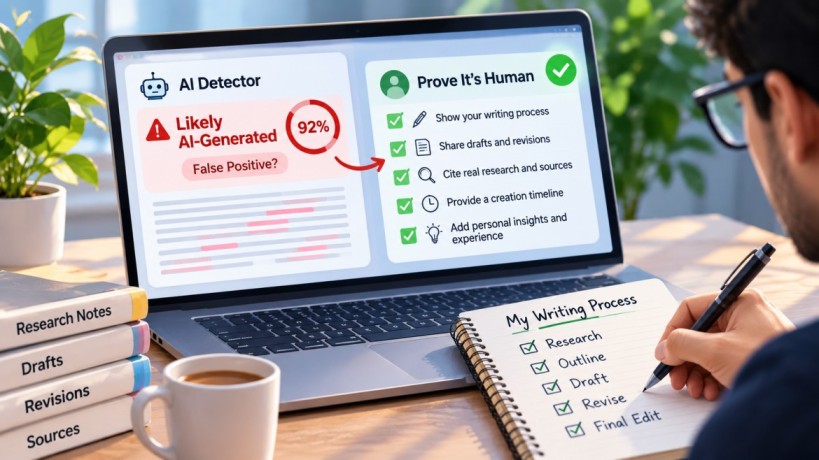
An AI detector false positive is when software labels human writing as AI-generated. It happens often, because detectors guess from word predictability, not proof. Even OpenAI retired its detector for low accuracy. If you’re flagged, ask which tool was used, share your version history, and point the client to published error rates.
Table of Contents
What is an AI detector false positive?
An AI detector false positive is human writing that a detector labels as machine-written. It is a statistical guess going wrong, not evidence that you used AI.
Most detectors score how predictable each next word is, a measure called perplexity. Predictable text scores as “AI-like” (Stanford HAI).
Here is the uncomfortable part for content writers. Good web copy is deliberately predictable: short sentences, plain words, standard structure. The habits that make you readable can also make you look like a machine.
How often do AI detectors flag human writing?
More often than the marketing suggests. The only error rates you can trust come from the vendors’ own fine print or from peer-reviewed research.
| Detector | What is claimed | What the evidence shows |
| OpenAI AI Classifier (retired) | “Not fully reliable” at launch | Caught 26% of AI text, wrongly flagged 9% of human text, then shut down on 20 July 2023 (OpenAI) |
| Turnitin | Under 1% false positives per document | Applies only above a 20% AI score; sentence-level rate is about 4%; needs 300+ words (Turnitin) |
| Turnitin (trade-off) | Keeps false positives low | Accepts missing about 15% of AI-written text to do so (Turnitin FAQ) |
| GPTZero | 0.24% false positives | From GPTZero’s own 3,000-sample benchmark, not an independent test (Quetext summary) |
| Seven detectors tested by Stanford (2023) | Marketed as accurate | Flagged 61.22% of non-native English essays as AI (Stanford HAI) |
Be skeptical of 2026 “independent benchmarks” too. Many are published by sites selling a rival detector or a humanizer, and they disagree wildly.
One March 2026 test put Originality.ai’s false positive rate at 7% (Poignant Guide). Another 2026 test, cited by a review site, put it at 12% (BestWriting). Same tool, nearly double the error.
What are the odds you get falsely flagged this year?

Higher than you think, because small error rates add up across every piece you submit. We calculated the chance of at least one false flag in a year.
Formula: chance of at least one false flag = 1 − (1 − f) ^ n
Here f is the detector’s false positive rate and n is the number of human-written pieces you submit in a year.
| Pieces you submit per year | At 0.24% (GPTZero’s own claim) | At 1% (Turnitin’s claim) | At 9% (OpenAI’s retired classifier) |
| 48 (4 a month) | 10.9% | 38.3% | 98.9% |
| 96 (8 a month) | 20.6% | 61.9% | over 99.9% |
| 240 (20 a month) | 43.8% | 91.0% | over 99.9% |
Read the middle column carefully. At Turnitin’s best-case rate, a writer filing 8 pieces a month is more likely than not to be wrongly flagged at least once a year.
This is a model, not a measurement. It assumes each piece is independent and the error rate stays constant. Real rates swing with topic, length and writing style.
It also understates the risk if a client checks with several tools. In the Stanford study, 89 of 91 human essays were flagged by at least one of seven detectors (Stanford HAI).
Why are non-native English writers flagged more often?
Because detectors read a smaller vocabulary and simpler sentence structures as machine-like. The Stanford team found detectors were near-perfect on essays by US eighth-graders but flagged 61.22% of TOEFL essays (Stanford HAI).
The senior author, James Zou, tied this to perplexity. Non-native writers tend to score lower on lexical richness and syntactic complexity, so their text looks predictable.
Turnitin disputes that this applies to its tool. It reports no statistically significant gap between native and non-native writers for documents over 300 words (Turnitin). That is a vendor-run study, so weigh it accordingly.
One caveat matters for writers in India and elsewhere. The Stanford essays came from Chinese students, not professional writers. The mechanism likely applies more widely, but nobody has published a study on freelance web content specifically.
Does Google penalize content that detectors call AI?
No. Google ranks on quality and says it rewards high-quality content however it is produced (Google Search Central, 8 February 2023).
What Google does penalize is using automation, including AI, mainly to manipulate rankings. That is a spam-policy question about intent and quality, not a detector score.
So when a client rejects work for an “AI score”, it is a client policy, not an SEO requirement. Knowing that changes how you argue your case. For tools that genuinely help your output, see our guide to the best AI tools for content creators.
Should you run your own work through a detector?
Only when a client has named the tool. Otherwise you create a number you then have to defend, from a tool that may disagree with theirs.
| Your situation | Pre-check your work? | Why |
| Your contract requires a passing score on a named tool | Yes, with that exact tool | Detectors disagree, so only the client’s tool counts |
| Your client has no detector policy | No | You gain nothing and risk an argument over a meaningless number |
| You are a non-native English writer with overseas clients | Yes, and keep full version history | Your false-positive risk is higher, so prepare evidence early |
| You used AI for research or a first draft | Disclose it rather than chase a score | Rewriting until a tool says “human” proves nothing about authorship |
Skip “humanizer” tools entirely. The Stanford team showed a simple prompt to make AI text more literary fooled detectors (Stanford HAI). Scores measure style, not who wrote the words.
Try this yourself: run an article you published before 30 November 2022, when ChatGPT launched, through two free detectors. Any AI score above zero is a false positive, and a screenshot of it is useful evidence if a client ever questions your work.
What should you do when a client says your work is AI?
Respond with evidence, not emotion. Six steps, in order:

- Ask for specifics. Which tool, what score, and which passages were flagged. Different tools give different answers on the same text.
- Share your version history. Google Docs keeps timestamped edits under File, then Version history. Hours of edits are hard to fake.
- Send the vendor’s own fine print. Turnitin says scores under 20% are less reliable and about 4% of flagged sentences are human (Turnitin).
- Offer a live check. A 15-minute call to walk through your research notes and sources settles most disputes fast.
- Disclose honestly. If you used AI for outlining or research, say so plainly. Hidden AI use, once found, ends trust far faster than a false flag.
- Fix the contract. Add a clause stating detector scores alone are not proof, and that version history counts as evidence.
Conclusion
AI detectors are probability tools that vendors market as proof. Even at their own best claimed error rates, a busy writer will likely be wrongly flagged at some point.
You cannot control the detector. You can control your evidence: version history, research notes, honest disclosure, and a contract that treats a score as a question, not a verdict.
Can an AI detector prove I used ChatGPT?
No. Detectors output a probability based on writing style. OpenAI withdrew its own detector in July 2023 because it was not accurate enough (OpenAI).
Why was my writing from before ChatGPT flagged as AI?
Because detectors judge style, not dates. Clear, simple, well-structured prose looks predictable to them, whoever wrote it and whenever.
Which AI detector has the lowest false positive rate?
No independent test settles it. GPTZero claims 0.24% on its own benchmark, and Turnitin claims under 1% above a 20% score. Neither has been confirmed by peer-reviewed research on web content.
Will Google rank my article lower if a detector says it is AI?
No. Google says it rewards quality content however it is produced, and targets automation used mainly to manipulate rankings (Google Search Central).
Should I tell clients when I use AI?
Yes, if you used it for drafting or research. Disclosure up front protects you far better than any detector score.